An Obituary for Ecology and a Manifesto for Positive Environmentalism
First published in Slovenian in 2018, as the afterword to the Slovenian edition of Timothy Morton’s Hyperobjects (Založba Krtina).
The end of the world has already happened – we just failed to notice. Global warming, plastic in the oceans, plutonium that will outlast all of recorded history: hyperobjects are too vast to see, and we are living inside them. Björk sang it first; Timothy Morton gave it a name.
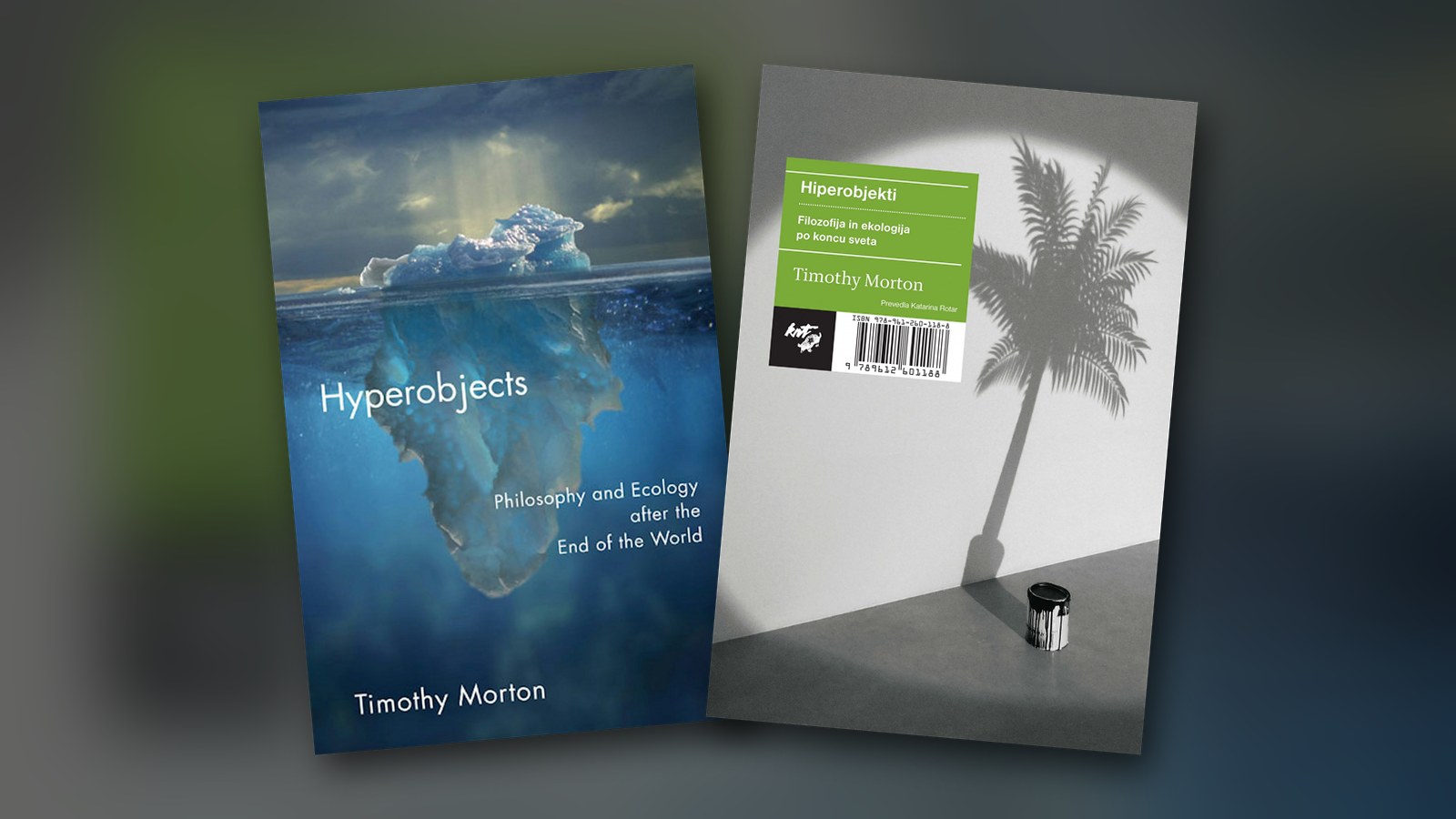
- Slovenian edition
- Timothy Morton, Hiperobjekti: filozofija in ekologija po koncu sveta, trans. Katarina Rotar. Ljubljana: Založba Krtina, 2018.
- Original
- Hyperobjects: Philosophy and Ecology after the End of the World. Minneapolis: University of Minnesota Press, 2013.
- Afterword
- by dr. Blaž Mazi; Slovenian title Osmrtnica ekologije in manifest pozitivnega okoljevarstva.
Translated from the Slovenian with AI help. Checked quotations are marked ✓; the rest are paraphrased. How quotations are handled
“We live on a mountain / Right at the top / There’s a beautiful view / From the top of the mountain / Every morning I walk towards the edge / And throw little things off / Like car-parts, bottles and cutlery / Or whatever I find lying around / It’s become a habit / A way to start the day / I go through all this / Before you wake up / So I can feel happier / To be safe up here with you,”✓ sings the Icelandic singer Björk in her hypnotic 1996 song “Hyperballad”, while the video unspools the signature images of her avant-garde poetics. “It’s real early morning / No-one is awake / I’m back at my cliff, still throwing things off / I listen to the sounds they make / On their way down / I follow with my eyes ’til they crash / Imagine what my body would sound like / Slamming against those rocks.”✓
From the correspondence1 shown in 2015 as part of her retrospective at the Museum of Modern Art in New York, we learn that, in search of theoretical answers about her own artistic language, she turned to none other than Timothy Morton, a professor at Rice University in the United States. In all these years, Björk admits in her second letter, she has managed to avoid being analysed, but now that she is older she wants to meet theory halfway. In the same letter she asks Morton to help her work out which “ism”✓ she belongs to. She finds posthumanism interesting, and the Anthropocene even more “spicy”,✓ and she openly invites Morton to define it not only for her but “for all my friends, and a generation actually”.✓ Thrilled that his long-time muse had written him a real letter, Morton replied at once: “I think I’ve had your music and words in me for decades—I mean this word I use, ‘hyperobject’ for instance, it sounds like one of your words. You have so many nonhuman beings in your work, both obviously alive and not so obviously. I tend to see things in an animistic way. I try to argue that everything is alive (or undead—almost as good!). … I think art is a way to talk about the way things are in general: an umbrella, Sagittarius A, coral, breadcrumbs, photons. I believe art is a way to attune to what reality is, which is a weird reality.”✓
Make no mistake: Hyperobjects is above all a book about how weird our reality turns out to be once we look at it in the light of what the twentieth and twenty-first centuries have taught us. The true nature of things remains unknowable; we can hear it only in the echo of things striking the rocks as we hurl them towards the horizons of knowledge in giant hadron colliders. “I have no idea what ism you are really of course (he said sincerely and truthfully), and my own ism doesn’t seem to have made itself very obvious! That is part of the whole ism dynamic, of course, which we humans have been in for about two hundred years,”✓ Morton added in the same exchange. Anyone familiar with the visual world of the Icelandic artist’s songs might take it for hysterical exaggeration, or for the hallucination of a restless artistic spirit. But Morton tells her in passing that he believes art “comes from the future”✓ and is “always ahead of thinking”.✓ Art expresses what thought only later manages to put into concepts – and, as far as hyperobjects are concerned, that is exactly what Björk achieved. She was the canary in the coal mine, laying bare with every new work that the art of the future was already here. Hyperobjects have already arrived. The end of the world has already happened. Björk is the least weird thing in all this; what is (and was) truly weird is the world she (still) sings about.
If we look at Morton’s two best-known books, Ecology without Nature and The Ecological Thought, it is clear that he does not see himself as a classical thinker. In Ecology without Nature, his most cited book, he draws on Plato’s dialogue Ion and its poets – the rhapsodes – to introduce the notion of ecorhapsody. He traces the origin of the term he uses for nature writing to the Greek words οἶκος and μίμησις. Nature writing is thus the mimesis (imitation) of the oikos (the environment) – ecomimesis – and Morton insists that this is not mere skilful imitation. No: for him ecomimesis is a strong, magical form; not a copy at all, but a compelling illusion in the service of rendering.2 For Plato, as is well known, mimesis is a divinely inspired form of madness. “This is not simply a matter of copying forms, but of being plugged in to a source of inspiration, ‘mainlining’ reality.”✓3 The poet is a rhapsode (from the Greek rháptō, “I stitch, I sew”, and ōidḗ, “song”), mimesis is a form of rhapsody, and the extended definition of rhapsody points even more clearly towards reading. Ecological rhapsody is a reading of the book of nature. “For Heidegger ‘man is the shepherd of Being’—he might as well have said that man is the rhapsode of being, a romanticized worker whose job is to hold it in mind. … The environment just happens around us, without our intention. Or it is the objectified, perhaps unintended consequence of an intention—intention’s echo.”✓4 Whoever thinks ecology is therefore, at bottom, a rhapsode of being: he holds it in mind and is at the same time struck by it. The philosopher of the twenty-first century can no longer be merely a thinker; he must be inspired. Morton, then, stitches together poems about reality. If philosophy came from the future, as in his view art does, he would be the one who wrote Björk’s lyrics. Reading Morton, we have the feeling that we are listening to Björk.
To be fair, the enfant terrible of environmental philosophy is also a pop philosopher, and many of his distinguished colleagues neither accept nor value him – partly because of the impression he makes (much as Björk does on many people), partly because of his rather idiosyncratic use of quantum mechanics and other theories of physics. On the other hand, he provokes enthusiastic responses and surprises with the originality of his thought. Morton is the spirit of the age, and the age has found in him room to express “that something more”. Environmental philosophy needed a way through the dichotomies of idealism and realism. Someone had to take on Romanticism and the old ontologies with serious tools, and Morton cast the biggest hammer of all. He is a hyperproductive author: he publishes essays in series, speaks at exhibition openings in the best-known galleries in the world, posts videos of his lectures, dances at raves and teases the public on his blog Ecology without Nature,5 whose background is the red curtain from Twin Peaks. He was among the thinkers whom NASA invited to New York in November 2016 to discuss what the golden record on a possible successor to the Voyager mission should contain. Since this was the week after the American election and Donald Trump’s victory, he tweeted that he was on his way to talk with NASA about what to put on the next Voyager – and that he would propose the president.6 His ideas are not only read and used by philosophers. As Britain’s Guardian observed in a long profile that crowned him “the philosopher prophet of the Anthropocene”,✓ his terminology – in the words of his friend Graham Harman quoted there – is “slowly infecting all the humanities”.✓7 Let us look at a few of the best known of these ideas.
In Ecology without Nature, where he takes environmental aesthetics apart, Morton issued a revolutionary call: true ecological thought is the kind that can let go of the concept of nature as such. An ecology that intends to renounce nature is in fact the heir to a relatively old environmental debate. Božidar Kante, for instance, observes that the aesthetic appreciation of nature is stretched between two poles: pure, pristine nature on the one hand and unlimited nature on the other. Pure nature is nature not yet touched by the human hand, and as such it is a fiction, since we know that no such nature is left in today’s world. The concept of unlimited nature, by contrast, takes in everything in the universe, particular and general, object or force, however it is recognised and whatever its origins.8 The story of how the concept of nature has been used and applied is also a story about ourselves. Through our bodies we are, in a very intimate way, part of nature; we are nature. And we know very well what it means to be nature. Asking what the essence of human existence is and how it might be summed up, the NASA astronomer Dr Michelle Thaller answers that it turns out to be quite simple: “We are dead stars looking back up at the sky”✓ – which is how she explains the fact that practically all the atoms in our bodies were formed in stars. The universe began with, and feeds on, the simplest element, hydrogen; all the other elements were forged in the birth and death of stars. Everything you are, Thaller adds – literally, the iron in your bloodstream – was formed in the moments when stars were dying. When you cut yourself and see the red liquid of oxidised haemoglobin, you are in effect looking at the dying moments of some solar system; your body literally is such a moment. She also points out that hydrogen is of course not available in unlimited quantities, which means that in time all the stars will go out and the universe will be in complete darkness, whatever that may mean. Astronomers such as Thaller are aware of the unique position of a humanity that uses the light of the Sun and its free energy to develop, to become sentient and to look outwards into the universe. How incredible it is, she says, that this is only a fleeting moment in the history of the universe; it is then that we realise “how wonderful this time is, how wonderful your life is”.✓ She wonders whether one day people will tell myths about the stars and their light.9
Morton is highly critical of the genre of nature writing, because it presupposes that the environment can actually be “translated”. He is convinced that nature writing is incapable of capturing and grasping nature, which is why its whole aesthetic is misguided and distorted. “’Ecology without nature’ could mean ‘ecology without a concept of the natural.’ … Ecological thinking that was not fixated, that did not stop at a particular concretization of its object, would thus be ‘without nature.’ … The aesthetic is also a product of distance: of human beings from nature, of subjects from objects, of mind from matter. Is it not rather suspiciously anti-ecological?”✓10 However we think about nature – whether for us it is the environment or other beings, animals, plants and so on – “it keeps collapsing either into subjectivity or into objectivity. It is very hard, perhaps impossible, to keep nature just where it appears—somewhere in between.”✓11 It is not only that pure nature never existed, not even before humanity arrived; we do not need unlimited nature either. Nature (or whatever we unsuccessfully try to picture under that concept) exists in such a weird way that we cannot really see it. We are not even looking in the right direction – not until we catch sight of hyperobjects.
The concept of the environment arose at the very moment the environment became a problem, Morton protests. “The very word environmentalism is evidence of wishful thinking. Society would be so involved in taking care of ‘it’ that it would no longer be a case of some ‘thing’ that surrounds us, that environs us and differs from us. … In a society that fully acknowledged that we were always already involved in our world, there would be no need to point it out.”✓12 Morton is convinced that the concept of space is not unified, independent and solid, and this leads him to develop a new kind of ecological criticism, which he calls dark ecology. Ecological thought of this kind admits from the outset that it has no way out of the paradoxes of the present. The aestheticisation of ecological thought is perverse: the more beautiful ecological souls there are in the world, the more plastic there is in the world’s oceans. Morton recalls the mystic who longs to touch the divine and compares him to deep ecology, which, with all its surfeit of biocentrism, wants to immerse itself in nature, give it absolute priority and clear its way. Both miss the mark, ending up either in mystical intoxication or in the glow of the sunset. “The ecological thought, the thinking of interconnectedness, has a dark side embodied not in a hippie aesthetic of life over death, or a sadistic-sentimental Bambification of sentient beings, but in a ‘goth’ assertion of the contingent and necessarily queer idea that we want to stay with a dying world: dark ecology.”✓13 Now is the time, Morton suggests, for grief to persist and ring throughout the world. Modern culture has not yet learned what to do with grief. Environmentalism both stokes and soothes the unbearable feelings that come with an atmosphere of general catastrophe – nuclear bombs and radiation, global warming and mass extinction. This is why he does not spare even the father of the environmental movement, Aldo Leopold. Ecocriticism, Morton warns, must be able to distinguish between the need to help others, or the other, to fulfil their “right to life” and, say, Leopold’s conservative ethic, defined by his best-known maxim: “A thing is right when it tends to preserve the integrity, stability, and beauty of the biotic community. It is wrong when it tends otherwise.”✓14 “Integrity, stability, and beauty are all aesthetic criteria,”✓ Morton adds. In devising his bright ecology, Leopold was aware that aesthetic arguments were the only ones left to him for a successful defence of environmentalism. The great American conservationist assumed that the (aesthetic) perception of the environment involves no consumption and uses up no natural resources; yet, as Morton replies, “This perception of wild nature is therefore consumerism without consumption, the pure form of consumerism.”✓15 Dark ecology is no occult science. It is exactly what its name announces: the science of a dark world, in which hyperobjects have eclipsed the Sun.
The essential feature of this book, and of Morton’s work in general, is that it shows clearly, for the first time, what environmental philosophy in the Anthropocene will look like. If in recent decades we were preoccupied with questions of pristine nature and wilderness – how much of the artefactual nature can contain and still be called nature – in Hyperobjects we realise that these debates have largely lost the wind from their sails. Human influence on the Earth and its environment is so great that we have begun to speak of a new geological epoch: the age of anthropos, of the human. Ecology without nature, dark ecology and the hyperobjects revealed by the Anthropocene are thus the holy trinity of a new ecological thought that makes no secret of its ambitions. Before we surrender to it, however, let us apply a little common sense. The final recognition of the age of the human will have to wait until human traces show up in the sediments, but the Anthropocene Working Group of the International Commission on Stratigraphy, through its press releases and public appearances, makes it known that official confirmation is only a matter of time. [Editor’s note, 2026: this did not happen. In March 2024 the International Union of Geological Sciences upheld the vote of its Subcommission on Quaternary Stratigraphy rejecting the Anthropocene as a formal epoch of the Geologic Time Scale; the term remains in wide informal use ([IUGS–ICS statement, 20 March 2024](https://stratigraphy.org/news/152)).] The carbon dioxide in the atmosphere, the plutonium that twentieth-century nuclear tests scattered across the world, the sixth extinction and the microplastics in the world’s oceans speak for themselves. Jan Zalasiewicz, the head of the group and one of the leading experts on the Anthropocene, explained to the journalist Barbara Belehar Drnovšek on Intelekta, a programme of Radio Slovenia’s first channel, in an episode entitled “Welcome to the Anthropocene”,16 that every potential new geological epoch in stratigraphy has a working group of experts who otherwise study that particular period. With the Anthropocene things were somewhat different: the group included not only geologists like himself, who work on old rocks, but also geographers, chemists, archaeologists and even an international lawyer. The Holocene, he said, has lasted eleven thousand years; if the Anthropocene is adopted, and if it is taken to begin in the mid-twentieth century, it is a truly short period, and we have not yet really felt its full dimensions. Geological epochs, then, last millions and thousands of years, not decades. With a revolution or a paradigm shift we really do wake up in a new world, but we are left with a small (or not so small) problem: the structures of the old paradigm are never razed to the ground. They persist, and in places they prop up the shaky foundations of the new science. This is how I understand the concept of the natural, or of naturalness. In environmental aesthetics and the aesthetics of nature it still holds that nature is a fruitful concept. To abandon it would, in the view of some authors, be like trying to eat a watermelon without teeth. Or a knife. It is true, though, that Morton is not eating one watermelon; he would like to devour all the watermelons on the planet. At once, if possible.
Although many things happen because of our presence, many do not: natural phenomena such as insects and plants, and natural events such as falling rain and the mating behaviour of birds, are all around us, even in the middle of our civilisation’s greatest cities.17 Calling something a hyperobject does not mean that it is not also, in some way, natural in the old sense of the word – the sense Morton fights against so doggedly. Our Sun, too, is subject to gravity, and that, at least, I would guess we humans have not yet influenced. “The naturalness that persists in human-altered or human-impacted nature is a seriously important object of valuation. Unless one ignores a central point maintained by defenders of the natural—that naturalness comes in degrees,”✓18 Ned Hettinger warned a year after Hyperobjects first appeared. On the Earth’s surface there is less of it in the city than in the countryside, and somewhat more on the Moon, except where spacecraft landed and astronauts walked. We can imagine that the Voyager programme mentioned above, with its probes Voyager 1 and Voyager 2, is “culturalising” the universe: every second, Voyager 1 enlarges the sphere of human influence by a good 62,000 kilometres, and in doing so destroys the virgin landscape of interstellar space. Hettinger (and others) recognise a characteristic pattern among the most passionate advocates of the Anthropocene: for nature to really be nature, it must be virginal and untouched, and since no such nature is left, we have either reached the end of the natural or are unable to see the omnipresent imprints of human action. What we can hold against Morton and the other prophets of the Anthropocene is at least this: even in our weird reality there is still some potential for renaturation and for the self-renewal of natural areas. Humanisation can “flush out”✓ of natural systems, Hettinger stresses, for there is “the real possibility for greater degrees of naturalness to return”.✓19 Nature, of course, cannot go back into the past, but it is enough to remove or relax human influence. George Monbiot described remarkable examples of this in Feral (published in Slovenian as Naprej k naravi), and he also ventured into the Rajhenav virgin forest in Kočevski Rog.
At this level ecology can hardly do without nature, nor is it so damned dark, and the wonderful examples of renaturation promise that, perhaps, in the geological sense the Anthropocene will one day be no more than a thin line in a core of sediment. But these are remnants of the old paradigm, Morton would say. So let us set out, with a pinch of salt, into the landscape of the new paradigm. “When you feel raindrops, you are experiencing climate, in some sense. In particular you are experiencing the climate change known as global warming. But you are never directly experiencing global warming as such,”✓ Morton might warn us on a rainy day’s visit to the Kočevje virgin forest. At that moment we would be no more than “one of the entities caught in the hyperobject I here call global warming”,✓ he would go on, adding in passing that he does not agree with calling what is happening climate change.
Hyperobjects turn the traditional understanding of objects on its head and thereby unsettle the relation between subject and object. They are objects that we humans simply cannot see, because they elude the representational power of the mind; we cannot in any adequate way (to use Kant’s language) apprehend them. They are distributed through space and stretched through time in units alien to human perception. “A hyperobject could be a black hole. A hyperobject could be the Lago Agrio oil field in Ecuador, or the Florida Everglades. A hyperobject could be the biosphere, or the Solar System. A hyperobject could be the sum total of all the nuclear materials on Earth; or just the plutonium, or the uranium. A hyperobject could be the very long-lasting product of direct human manufacture, such as Styrofoam or plastic bags, or the sum of all the whirring machinery of capitalism. Hyperobjects, then, are ‘hyper’ in relation to some other entity, whether they are directly manufactured by humans or not.”✓ We might think of the sublimity of the Kantian infinite, but we would be wrong: “These gigantic timescales are truly humiliating in the sense that they force us to realize how close to Earth we are. Infinity is far easier to cope with. Infinity brings to mind our cognitive powers, which is why for Kant the mathematical sublime is the realization that infinity is an uncountably vast magnitude beyond magnitude. But hyperobjects are not forever. What they offer instead is very large finitude. I can think infinity. But I can’t count up to one hundred thousand.”✓ The hyperobject, in his words, “is not a function of our knowledge: it’s hyper relative to worms, lemons, and ultraviolet rays, as well as humans.”✓
What, then, are hyperobjects? In the first part of the book Morton sketches their properties, and it is important to be aware that hyperobjects have one crucial feature: we humans perceive only their aesthetic effects. Ecomimesis may well be a reading of the ecological book of nature, but when we try to find traces of hyperobjects while reading Reality, all we can make out are the aesthetic relations between objects. Hyperobjects reverberate through the world and give the false impression of being the echo of some ancient state in which harmony played everywhere.
A hyperobject is like a jar of honey into which we dip our hand – except that in real life we cannot see the honey, and we are in it all the time. Global warming is viscous. Wherever we go, it is always already there; it clings to us and will not let us out of its grip. The half-life of plutonium-239 is more than twenty-four thousand years, almost as long as visible human history. In the age of the Anthropocene, when in two hundred years we have pumped carbon out of the Earth and released it into the atmosphere, the aesthetics of nature cannot be what it was in Romanticism: “Thinking things as Nature is thinking them as a more or less static, or metastable, continuity bounded by time and space. The classic image of Nature is the Romantic or picturesque painting of a landscape. There it is, over yonder—on the wall in the gallery.”✓20 Their viscosity shows most clearly in the fact that they are already here. Morton discovers them late, already poisoned by them, and finds his hair falling out: “Like an evil character in a David Lynch production … hyperobjects haunt my social and psychic space with an always-already. … What the demonic Twin Peaks character Bob reveals, for our purposes, is something about hyperobjects, perhaps about objects in general. Hyperobjects are agents. They are indeed more than a little demonic, in the sense that they appear to straddle worlds and times, like fiber optic cables or electromagnetic fields. And they are demonic in that through them causalities flow like electricity.”✓ We haven’t thought about things this way, Morton observes, since the days of Plato. What Ion and Socrates called a daimon, we call the electromagnetic waves that amplify plucked guitar strings and broadcast them through a PA system. “Since the beginning of the Anthropocene, but particularly since the start of the Great Acceleration (the 1940s), these demonic channels have become more and more powerful. Human artists have become rhapsodes: Jackson Pollock, John Cage, William Burroughs.”✓
Hyperobjects are nonlocal. In post-Humean causality, Morton observes, it is by no means a matter of comparing “objective” and “subjective” impressions, still less human and nonhuman reality. It is a matter of “different levels of causality. It’s a matter of how entities manifest for other entities, whether they are human, or sentient, or not.”✓ Nuclear radiation turns the leaves of a flower a strange shade of red; global warming rots the tomato farmer’s tomatoes; plastic strangles the bird that gets caught in a set of six-pack rings. “What we are dealing with here are aesthetic effects that are directly causal. The octopus of the hyperobject emits a cloud of ink as it withdraws from access. Yet this cloud of ink is a cloud of effects and affects.”✓ These phenomena are not in themselves hyperobjects, Morton warns; what we face is an uncanny action at a distance. “A gamma particle is a wonderful example of a profound confusion of aisthēsis and praxis, perceiving and doing. A gamma particle is an ultra-high-frequency photon. In illuminating things, it alters things: flesh, paper, brains.”✓
The temporalities of hyperobjects are utterly different from the human-scale ones we are used to. “The recognition of being caught in hyperobjects is precisely a feeling of strange familiarity and familiar strangeness. We already know the weather like the back of our hand. But this is weird weather, this global warming weather.”✓ We think we know light, and then radiation confuses us again, because it is such weird light. Hyperobjects are like swimming in a pool. We are not the water and the water is not us, yet we make diffraction patterns on its surface, the water cools us and slowly seeps into the body. “Space can no longer be construed as an absolute container, but rather should be thought of as a spacetime manifold that is radically in the universe, of it rather than ontologically outside it.”✓ And: “I start the engine of my car. Liquefied dinosaur bones burst into flame. I walk up a chalky hill. Billions of ancient pulverized undersea creatures grip my shoes. I breathe. Bacterial pollution from some Archean cataclysm fills my alveoli—we call it oxygen. I type this sentence. Mitochondria, anaerobic bacteria hiding in my cells from the Oxygen Catastrophe, spur me with energy. They have their own DNA. I hammer a nail. In consistent layers of ore, bacteria deposited the iron in Earth’s crust.”✓
Hyperobjects are phased. “They occupy a high-dimensional phase space that makes them impossible to see as a whole on a regular three-dimensional human-scale basis. We can only see pieces of hyperobjects at a time.”✓ It is precisely because of this transdimensional quality that they appear nonlocal and temporally foreshortened: “We only see pieces of them at once, like a tsunami or a case of radiation sickness.”✓ The effects of hyperobjects show themselves to us interobjectively. It is a seemingly simple observation, namely that “they can be detected in a space that consists of interrelationships between aesthetic properties of objects.”✓ Let us return to our walk with Morton in the Kočevje virgin forest. The weather is falling on the whole group’s heads in the form of rain, but the philosopher would say that we are experiencing a poor photocopy of what we used to take for real: a sensory representation, a caricature of the global climate. “A process just is a real object, but one that occupies higher dimension than objects to which we are accustomed.”✓ Here it really is important to be aware that hyperobjects are not mathematical abstractions: they “don’t inhabit some conceptual beyond in our heads or out there.”✓ Hyperobjects are very real indeed, and their influence on other objects is very concrete and far-reaching. “Indeed the philosophical view behind thinking that objects are one thing and relations (which is what we’re really talking about when we talk about math or transcendence) are another positively inhibits our transition to an ecological age, even as it poses sophisticated theories of emergence or process.”✓ A phasing hyperobject is in fact like a giant octopus that comes up to check on things, squirts its ink and then vanishes. Or, put the other way round, a hyperobject approaches a certain fullness and then recedes. This is only how things appear, because we humans have limited access to hyperobjects. So much for the immediate philosophical, historical and cultural account. What, then, are we to do with this newly discovered aesthetic appearance of hyperobjects? What we humans always do. We will try to take possession of it!
The end of the world has already happened. It was brought about by the arrival of hyperobjects, but the world did not blow up. It is simply different. Weirder. When James Watt patented his steam engine in April 1784, that act set in motion the deposition of carbon in the Earth’s crust – and so humanity became a geophysical force on a planetary scale. This, in fact, is the heart of the notorious Anthropocene. The world also ended in 1945 at Trinity, New Mexico, with the test of the atomic bomb, and later with the flights over Hiroshima and Nagasaki. In the second part of the book, which describes the time of hyperobjects, Morton explains what the end of the world means to him. The world, he is convinced, is an aesthetic effect based on aesthetic blurring and distance, and the present-day blurriness of ecology and philosophy stems precisely from ignorance of objects. Only in such ignorance, in his view, can objects be blank screens onto which we project meaning. Without a world, there is no Nature, Morton writes, and he goes on: “Without a world, there is no life. What exists outside the charmed circles of Nature and life is a charnel ground, a place of life and death, of death-in-life and life-in-death, an undead place of zombies, viroids, junk DNA, ghosts, silicates, cyanide, radiation, demonic forces, and pollution. My resistance to ecological awareness is a resistance to the charnel ground. It is the calling of the shaman to enter the charnel ground and to try to stay there, to pitch a tent there and live there, for as long as possible. Since there are no charnel grounds to speak of in the West, the best analogy, used by some Tibetan Buddhists (from whom the image derives), is the emergency room of a busy hospital. People are dying everywhere. There is blood and noise, equipment rushing around, screams. When the charm of world is dispelled, we find ourselves in the emergency room of ecological coexistence.”✓ Only in the years after Morton’s book appeared did it become more widely known how big a problem the hyperobject of plastic in the world’s oceans and in the food chain really is, and what effects it has.
Morton devotes a great deal of space to the representation of hyperobjects in science and art, and on a first reading one may not fully understand why. It is essential to realise that, for properly understanding, thinking and “seeing” hyperobjects, the graph or the diagram makes sense. We do not see four hundred particles of carbon per million molecules of air with the naked eye, but powerful instruments detect them, and computers draw them for the human mind as graphs and tables – in this case the Keeling curve. Only science gives us access to hyperobjects, and with them to an entirely different picture of nature. Paradoxically, objects of very large finitude and countless relations are best understood when we reduce them to graphic abstractions of curves, points, graphs and diagrams. Only there, within the safe bounds of a screen or a sheet of paper, do we grasp that they exist. The representations of scientific discoveries are today a language of universality. The colours that trace the spread of nuclear contamination from Fukushima across the world’s oceans, viewed on an image of the globe, are a language almost everyone understands. Here, there, everywhere, there is something humans are in fact incapable of perceiving, yet, like a handprint in a cave painting, it bears witness to what is happening. Morton writes that “the trouble with global warming is that it’s right here. It’s not behind a glass screen. It is that glass screen, but it’s as if the glass screen starts to extrude itself toward you in a highly uncanny, scary way that violates the normal aesthetic propriety, which we know about from philosophers such as Kant—the propriety in which there should be a Goldilocks distance between you and the art object, not too close, not too far away. Global warming plays a very mean trick. … Human art, in the face of this melting glass screen, is in no sense public relations. It has to actually be a science, part of science, part of cognitively mapping this thing. Art has to be part of the glass itself because everything inside the biosphere is touched by global warming.”✓
The general aesthetic “feel” of the time of hyperobjects is, in his words, “a sense of asymmetry between the infinite powers of cognition and the infinite being of things.”✓ We are all taking part in a crazy arms race between what we know and what is. “The arms race sets new parameters for aesthetic experience and action, which I take in the widest possible sense to mean the ways in which relations between beings play out.”✓ Morton is not saying that environmentalism is no longer possible. Quite the opposite. In his view, the firm conviction that the world will end unless we act at once is precisely what prevents us from truly taking up ecological coexistence on Earth. “Thus, hyperobjects spell the end of environmentalisms that employ Nature (a tool of modernity) against modernity, fighting fire with fire, matter with matter, the present with the present.”✓ One might also think, he continues, that it was environmentalism and ecocriticism that pushed us out of modernity. “But in effect that was the last gasp of hot air inside the plane of modernity. What waited outside was a hyperobject, and it is responsible for pushing us out of the plane: we are now in the Age of Asymmetry.”✓
So what are we to do? Timothy Morton has fitted his house outside Houston with wind-generated electricity. After a few days of righteous ecological feeling, he realised that he could use whatever appliances he liked, and that he and his friends could party to loud music for hours or days on end while doing the planet far less damage. “And that’s the ecological future, actually,” Morton told the Guardian for its profile.✓ We do not see the wind as such, only its effects, when it shakes the treetops or drives a home wind turbine. The wind is, one way or another, a consequence of the hyperobject global warming – and who knows whether, at one of those parties, Morton did not also put on Björk’s “Jóga”: “All these accidents that happen / Follow the dot / Coincidence makes sense / Only with you / You don’t have to speak – I feel / Emotional landscapes / They puzzle me / Then the riddle gets solved / And you push me up to this: / State of emergency: how beautiful to be / State of emergency: is where I want to be.”✓
Notes
- https://www.dazeddigital.com/music/gallery/20196/0/bjork-s-letters-with-timothy-morton ↩︎
- I also wrote about ecomimesis and other topics touched on in this afterword in my doctoral dissertation, Estetski problemi sodobnega posredovanja, upodabljanja in ponarejenosti narave [Aesthetic Problems of Modern Mediation, Representation and Falsity of Nature] (Mazi, 2018). Translator’s note: this website is its English edition; hyperobjects are discussed in section 7.2. ↩︎
- Timothy Morton, Ecology without Nature, 2009, p. 54. ↩︎
- Ibid., pp. 58–60. ↩︎
- https://ecologywithoutnature.blogspot.com/ ↩︎
- https://web.archive.org/web/20211001230719/https://twitter.com/the_eco_thought/status/796356301169233920 Translator’s note: the tweet has since been deleted, so its wording is paraphrased here. ↩︎
- https://www.theguardian.com/world/2017/jun/15/timothy-morton-anthropocene-philosopher ↩︎
- Božidar Kante, Estetika narave [Aesthetics of Nature], 2009, p. 25. ↩︎
- https://web.archive.org/web/20140514070433/http://www.theatlantic.com/video/index/370784/we-are-dead-stars/ ↩︎
- Timothy Morton, Ecology without Nature, 2009, p. 24. ↩︎
- Ibid., p. 41. ↩︎
- Ibid., p. 141. ↩︎
- Ibid., pp. 184–185. ↩︎
- Aldo Leopold, Deželska etika [The Land Ethic], 2010, pp. 74–85. ↩︎
- Timothy Morton, Ecology without Nature, 2009, p. 194. ↩︎
- https://4d.rtvslo.si/arhiv/intelekta/174387265 ↩︎
- Glenn Parsons, Aesthetics and Nature, 2008, p. 3. ↩︎
- Ned Hettinger, “Valuing Naturalness in the ‘Anthropocene’: Now More than Ever”, 2014, p. 178. ↩︎
- Ibid., p. 179. ↩︎
- Timothy Morton, Hyperobjects: Philosophy and Ecology after the End of the World, 2013, p. 72. ↩︎