The Blue Marble: The Image That Turned Us into Terranauts
First written in Slovenian as the accompanying text for the exhibition Icons of the Non-visible (Ikone nevidnega), shown at the Cultural Centre of European Space Technologies (KSEVT) in Vitanje from 21 March 2015 until the end of 2016. The Slovenian text was also published on rtvslo.si on 18 April 2015.
There is an event that connects a human being with the world in a slightly unsettling way. Small children often stare into a mirror, yet for a long time they do not realise that they are looking at themselves.
- Exhibition
- Icons of the Non-visible (Ikone nevidnega), Cultural Centre of European Space Technologies (KSEVT), Vitanje, 21 March 2015 – 31 December 2016.
- Slovenian text
- Blaž Mazi, Modra frnikola: podoba, ki nas je spremenila v teranavte, rtvslo.si, 18 April 2015.
Translated from the Slovenian with AI help. Quotations are paraphrased, with their sources kept. How quotations are handled
With that realisation a completely new self-image takes shape, and a new sense of the scale of existence. When we talk about the power of images, concepts and ideas – about who we are, where we are and where we belong – it is worth remembering that men and women burned at the stake, wasted away in prisons, died in wars and risked their lives when the Earth had to be placed in humanity’s picture of the universe. Revolutions in the heavens and on the ground moved planets, eclipsed the Sun and in the end simply pushed the Earth out of the centre of creation. Over the years, the first photograph of the whole planet from space became an icon. Like all icons it has faded somewhat with mass use, and eyes are now turned to other symbols, but in the museum of human history it will stay on the wall of famous images that changed the course of history.
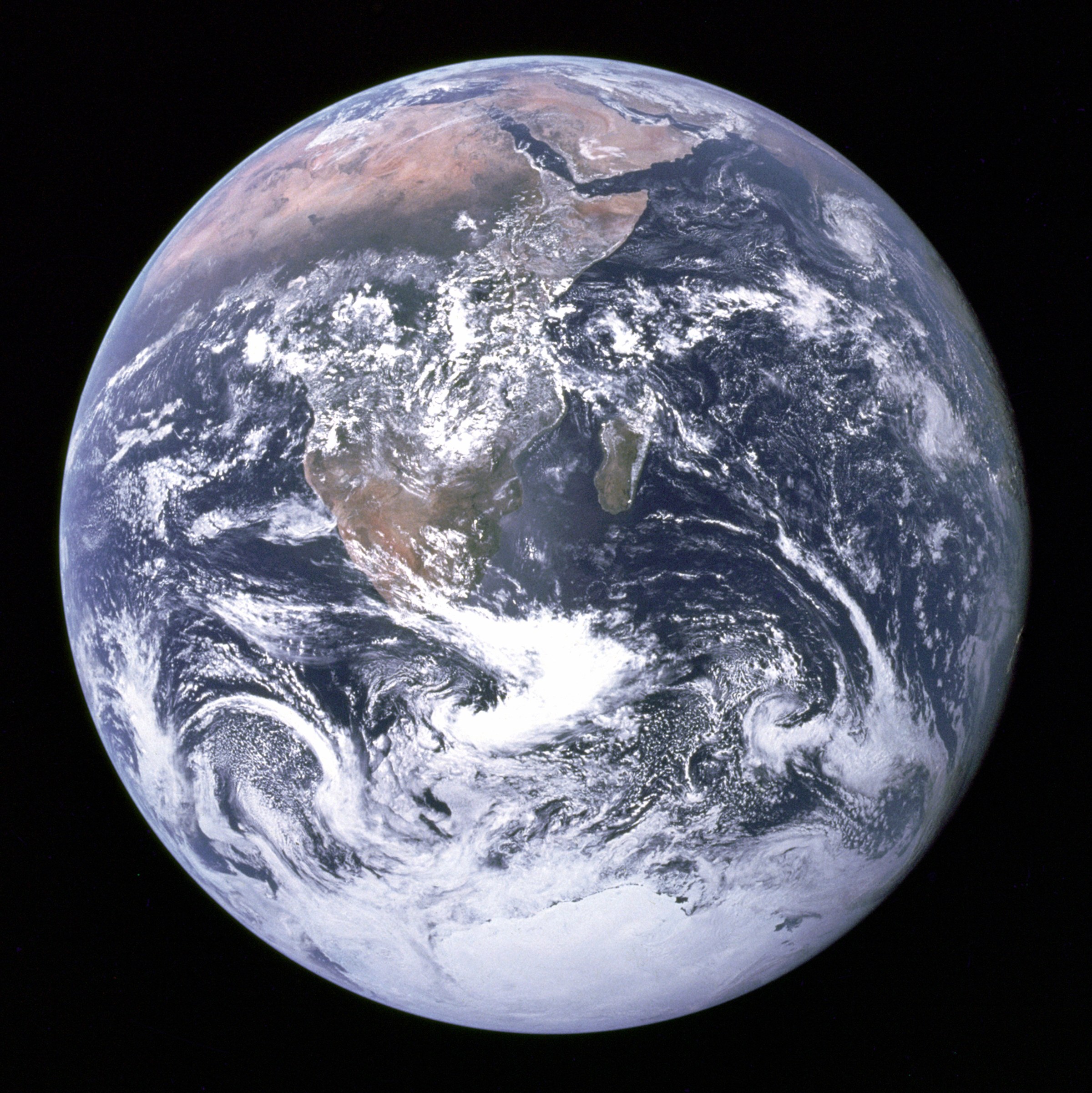
On 7 December 1972 conditions were favourable enough for the crew of Apollo 17 (Eugene Cernan, Ronald Evans and Jack Schmitt) to take what is perhaps the most subtle, influential and most cited photograph of our time. As Apollo 17 travelled along its planned path through space towards the Moon, the Sun was behind the astronauts and the whole Earth was fully lit. To Cernan, Evans and Schmitt it looked small, floating in the vastness of space and wrapped in a thin layer of translucent, glass-like atmosphere. With its white clouds, its green and brown land and its blue oceans, it resembled a fragile bluish marble.

It is true that the Blue Marble (the original is upside down, with the South Pole at the top of the globe) was not the first picture of the whole Earth from space. Similar pictures had been coming from satellites since 1967. In 1968, for instance, the American counterculture publication Whole Earth Catalog chose a satellite picture of the whole Earth for the cover of its autumn issue. Yet only four years later did the colour photograph The Blue Marble truly stir people, the philosopher David Fideler observes. Only when we left the world behind us as a whole for the first time, he writes, could we reawaken and feel more deeply humanity’s cosmic bond with its home planet.1 We had to go far enough away to see ourselves in the distance of space. After that, the world was no longer the same. It could not be. Our sense of the space we live in had widened. With the help of the Blue Marble, in the years that followed every inhabitant of the planet could see, and become aware of, where they actually live.

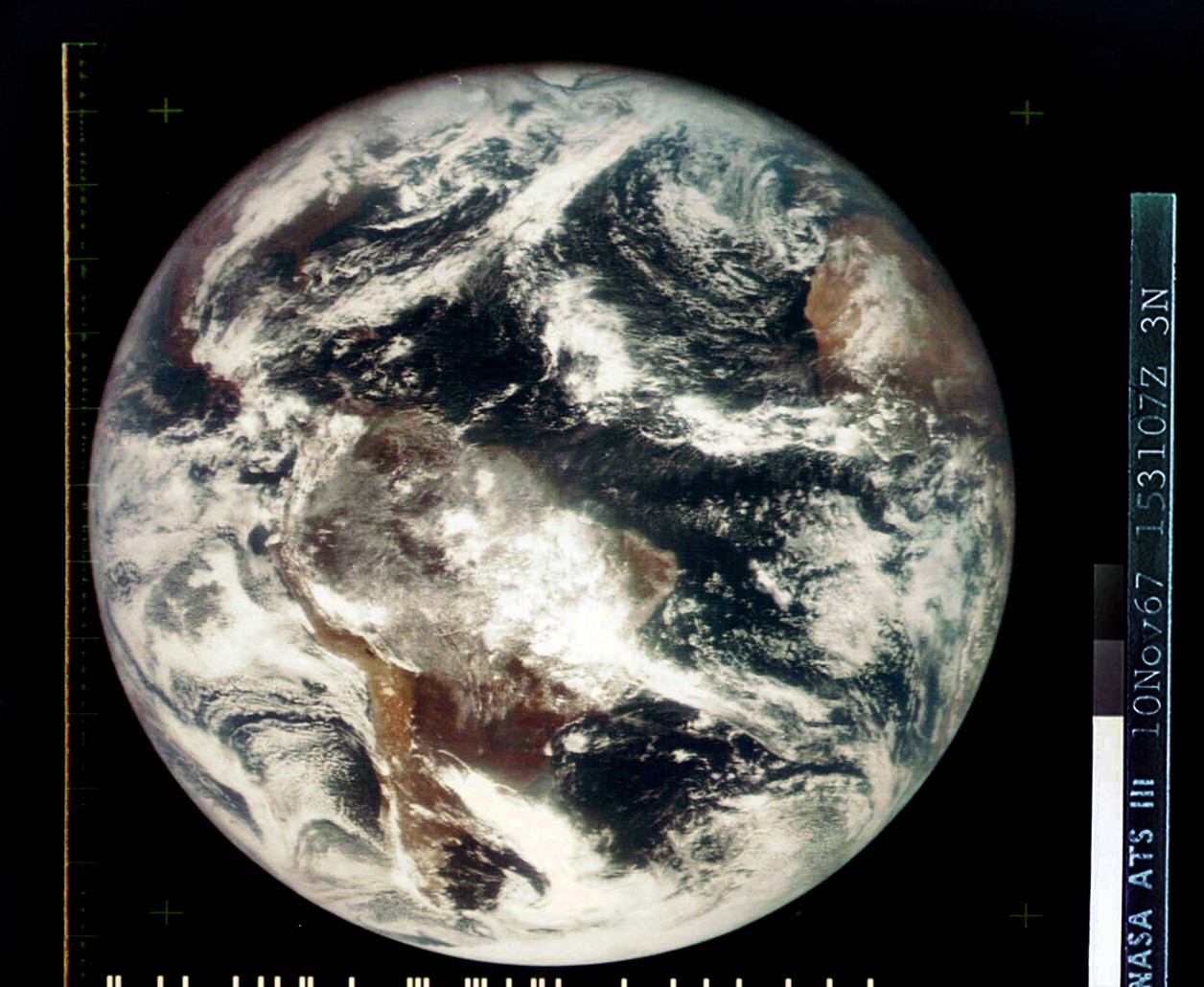
Given that Apollo 17 was the last crewed mission to the Moon, the 1972 photograph is a monument to human space exploration, an artefact of the age of space travel. Since that December day nobody has travelled far enough into space to photograph the whole Earth. On their last journey to the Moon, people took with their own hands the first photograph to capture our planet in full. The historian of the United States Kendrick Oliver points out that, for centuries before the space age offered a view of the real thing and caught it on camera, people had been highly inventive in imagining the Earth as a planetary globe; such views were widely anticipated before the lunar missions (which, after all, made them possible), and the anticipation was often charged with expectations of particular social effects. Logistically, photographing the home planet as a fully lit sphere was an immensely complicated task: travelling at more than 32,000 kilometres per hour, the crew had to pass through a narrow, almost point-like window between the Earth and the Sun. Some people realised that such an opportunity must not be missed.
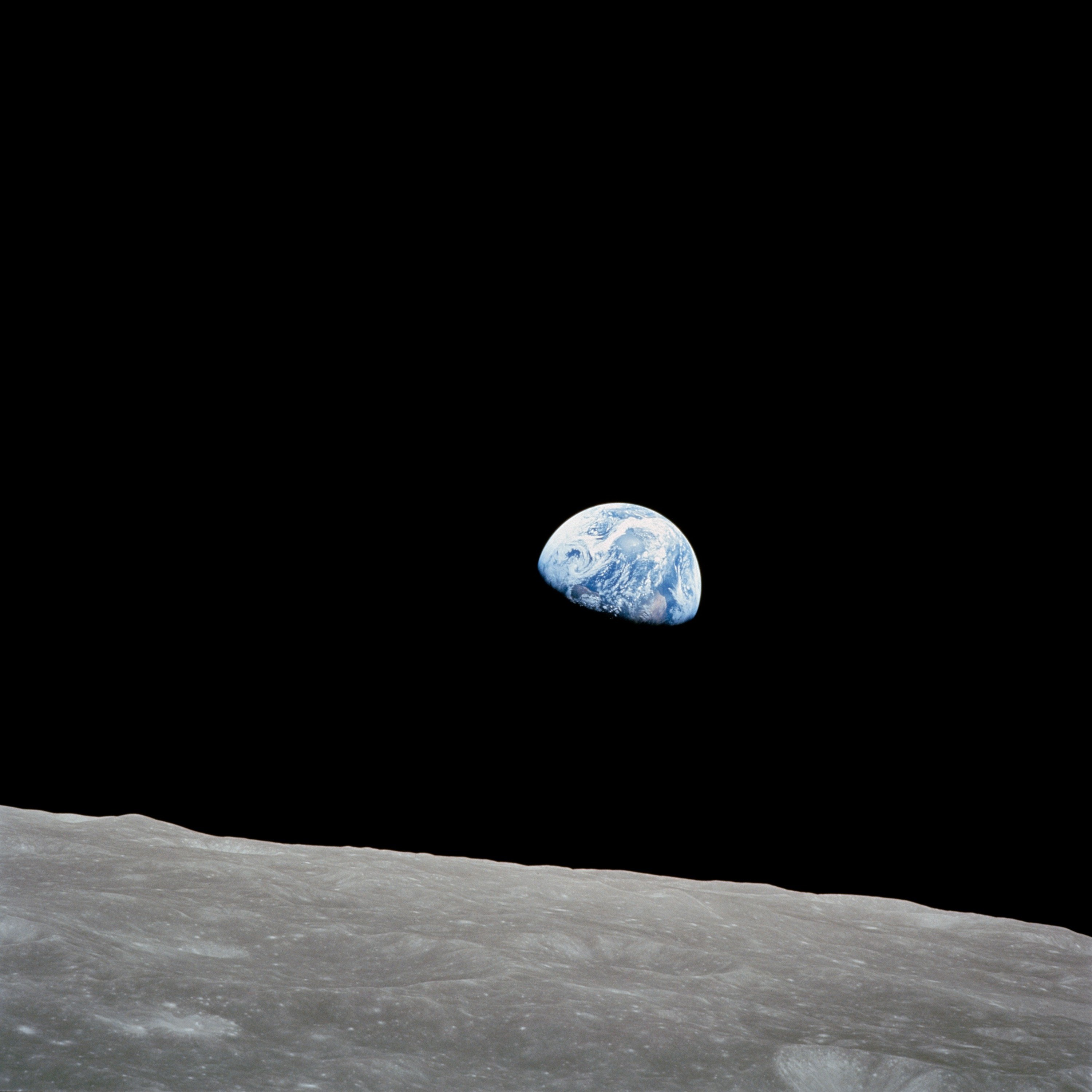
In 1968 Richard Underwood, who was responsible for photography on NASA’s space missions, had specially briefed the crew of Apollo 8 on the logistics needed to capture an image of the Earth rising above the lunar horizon. On the basis of that briefing the crew went on to take the famous photograph Earthrise. Four years later it was again Underwood who worked out that Apollo 17’s night launch would offer an unprecedented chance to see a perfectly round, unshadowed Earth. He told the lunar module pilot Schmitt that this would be the classic image and impressed on him that he must be sure to take it once they had lifted off towards the Moon.2
The Apollo 11 astronaut Michael Collins noted that as early as 1948 the British astronomer Fred Hoyle had predicted that the first photograph of the whole Earth would release a flood of new ideas.3 Precisely because it was taken in space by people, the Blue Marble is a document of human ingenuity and pioneering spirit. The photograph shows vividly what only astronauts see – those few men and women who, from their bodies in the sky, look down in our place and on our behalf, and so give the rest of us new experiences, and with them new views of what was previously invisible. Only twenty-four astronauts have travelled to the Moon. They either landed on it, orbited it or flew around it and returned to the Earth. Twelve people have walked on its surface.
As the philosopher Frank White, who interviewed Cernan, points out, the Apollo astronauts with their extraterrestrial experiences make up a vanishingly small share of the planet’s population. “Gene” Cernan recalls the view of the Earth: in that moment, he says, you see humanity, love, feeling and thought, and none of the racial, religious and political barriers that divide the world; and you wonder whether people would not feel differently if everyone on Earth could be taken up there.4
The three men of the Apollo 17 crew were the last people to see the whole Earth from space with their own eyes. White brought together the experiences of many astronauts (from various programmes) and cosmonauts. After careful study he found what they have in common: at the sight of the Earth they are deeply moved by their home planet. Their “aha!” moments are so similar that he gave them a single name, the overview effect.
For the rest of us mortals, the overview effect can be experienced only through the medium of the image. Experiences on Earth cannot, of course, be compared with experiences in space, but photographs, films and digital images can be produced more easily and cheaply than giving thousands upon thousands of people the experiences of astronauts. According to White, people exposed to the overview effect in this way sometimes undergo a transformation as strong as the astronauts’, and even less predictable.5 People who have reached the astronauts’ “consciousness” without travelling into space White calls terranauts. As soon as the Blue Marble was released to the public, it became a tool for anyone trying to depict environmental awareness. It has been used on countless occasions and in countless ways. A few vague and unreliable sources even suggest that it influenced the founding of the United States Environmental Protection Agency and environmental awareness as such.
As with every icon, some revere it, others despise it, and others again rightly question its real power. Either way, we talk about it and – whether we realise it or not – we keep encountering it and looking at it. Oliver’s reflection on the historical circumstances of its making is also revealing. That this new way of regarding the Earth, religious or otherwise, developed just as humans launched themselves into space was, in his view, largely a matter of poetic coincidence: the space programme did not inspire Rachel Carson to write Silent Spring in 1962, the first book of environmentalism.6 According to him, true environmentalists at the time saw such a joyride, undertaken while the home planet was being poisoned, polluted and turned into desert, as something decadent.
On the other hand, it is striking that the first official Earth Day, on 22 April 1970, unexpectedly drew almost 20 million Americans expressing their growing concern for the environment. The space for the Blue Marble in people’s minds already existed, and the image filled it with great success.
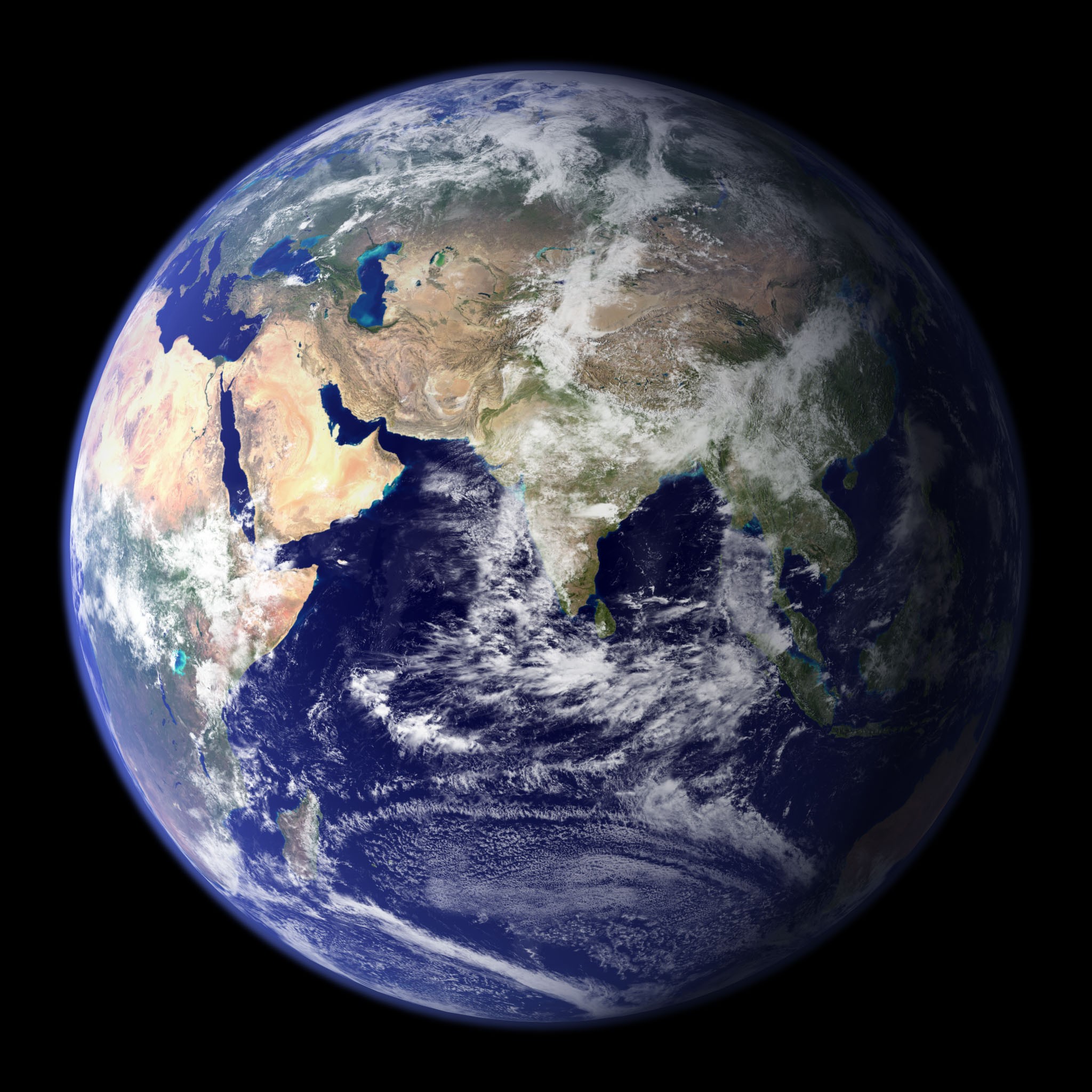
Later, newer versions of the Blue Marble were stitched together digitally from many images of the Earth’s surface taken by the Terra satellite. The version used as the background on many generations of iPhone screens is, of course, not a single high-resolution picture but a carefully assembled composite (of various photographs) with as few clouds as possible over the continents, and – unlike the 1972 original, with Africa at its centre – it is centred on the Americas. Apple’s choice of the Earth as its default wallpaper did much to spread images of the Earth from space and to make them popular with younger generations and in other parts and cultures of the world.
Whatever our cultural criticism or consumer cynicism, the Blue Marble and its later versions played a key role in our awareness of our shared environment and in shaping the metaphors of environmentalism. Before Earthrise and the Blue Marble, we knew nature (and the Earth in general) mostly from the point of view of landscape. Now, after all the events described above, we can also see nature from the perspective of the Earth as a whole. Irene J. Klaver is therefore convinced that, besides their explicit role, images also play an implicit one: they can be read as heralds of changes in mindset and attention, marking the emergence of a new way of thinking and so its continuation. Klaver draws on the work of Benedict Anderson, who treats imagination in the context of the nation-state. In his 1983 book Imagined Communities, Anderson defines the nation as an imagined political community. It is imagined, he explains, because the members of even the smallest nation will never know, meet or even hear of most of their fellow members, and yet each of them carries in mind an image of their community. For Klaver, the Blue Marble offers a clear example of how images in our world are not merely signs waiting for our interpretation but are forcefully present in our lives and have great influence. She believes that images such as Earthrise and the Blue Marble played an important role: in the last three decades of the twentieth century, she writes, a new image of the human community emerged – humanity at its home base, the Earth – and it began to work alongside the image of the nation-state.7
In an age of mass media, migration, population growth, globalisation, technological development and environmental change, it is clear that life on Earth will be an enormous challenge for future generations. In the distant future, when humanity travels still further into space, it will discover new images and new icons. Whatever happens, there is no doubt which will be the first: the one that shows, in the vastness of space, a tiny, floating, fragile blue marble that we all call our one and only home.
Notes
- David Fideler, Restoring the Soul of the World: Our Living Bond with Nature’s Intelligence, 2014, pp. 225–226. ↩︎
- Kendrick Oliver, To Touch the Face of God: The Sacred, the Profane, and the American Space Program, 1957–1975, 2012, pp. 126–127. Translator’s note: the Slovenian original gives the author’s name in reverse order, as “Oliver Kendrick”. ↩︎
- Michael Collins, Carrying the Fire, 1974. ↩︎
- Frank White, The Overview Effect: Space Exploration and Human Evolution, 1998, p. 37. ↩︎
- Ibid., p. 67. ↩︎
- Oliver, To Touch the Face of God, p. 49. ↩︎
- Irene J. Klaver, “Landscape of the Environmental Imagination: Ranging from NASA and Cuyahoga Images to Kiefer and O’Keeffe Paintings”, in Martin Drenthen and Jozef Keulartz (eds.), Environmental Aesthetics: Crossing Divides and Breaking Ground, 2014, pp. 135–153. ↩︎