7. Space: Apollo on the Moon Discovers the Earth
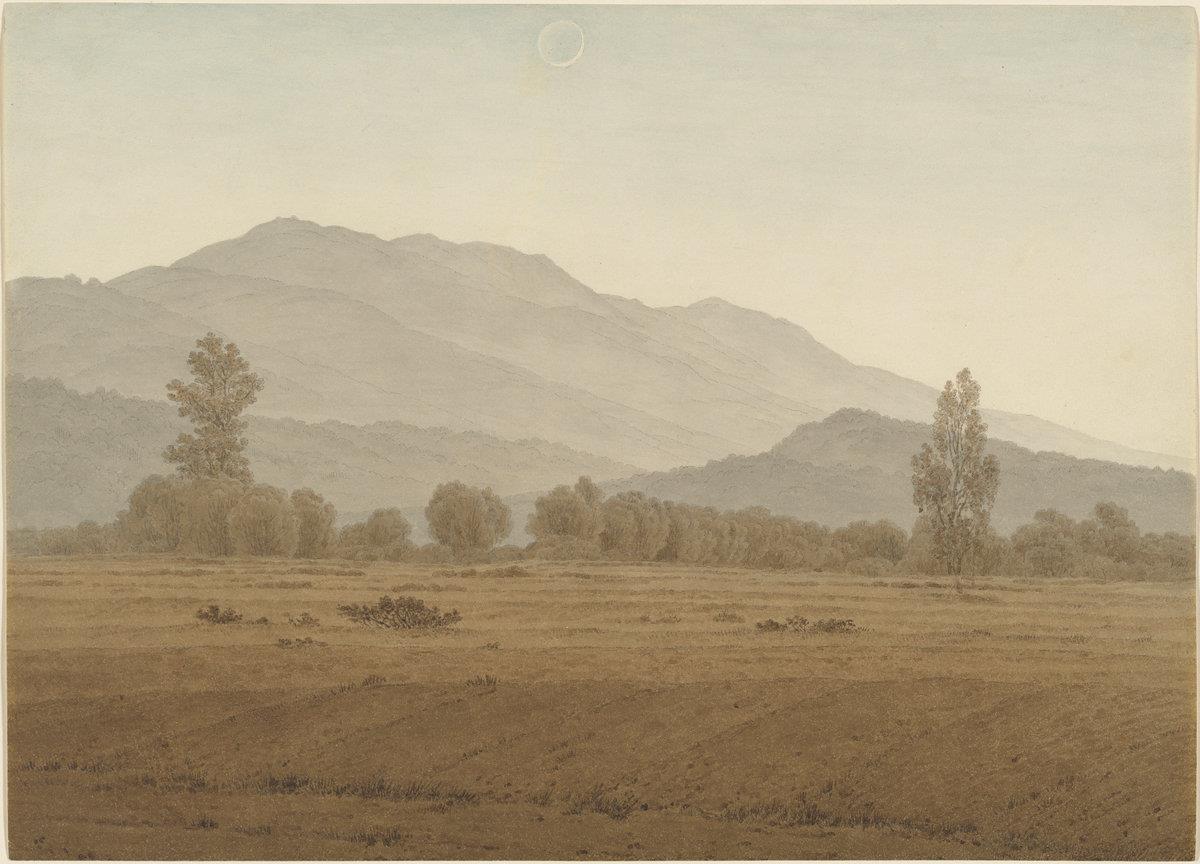
One of the most important landscape painters of northern Europe was Caspar David Friedrich, who worked in the first half of the nineteenth century. Although he studied nature closely on walks through various landscapes and acquired an exceptional knowledge of the transformations of natural phenomena, he made his paintings in the studio with the help of sketches and drawings from the field. With the help of imagination and contemplation he poured empirical data and experience onto the canvas. Neuer Mond über dem Riesengebirge is a landscape painting, but it also shows the Moon. In the years when it was painted, interest in landscape prevailed in the aesthetics of nature, and no one could really imagine that one day people would walk on the Moon and look at the Earth. Friedrich’s time was certainly not uninteresting. The great scientist and thinker Alexander von Humboldt, on his return from his expedition through South America, created the so-called Naturgemälde. During his ascent of the almost 6,400-metre-high volcano Chimborazo, then considered the highest peak in the world, he had a very particular realisation: “Looking down Chimborazo’s slopes and the mountain ranges in the distance, everything that Humboldt had seen in the previous years came together. … As he stood that day on Chimborazo, Humboldt absorbed what lay in front of him while his mind reached back to all the plants, rock formations and measurements that he had seen and taken on the slopes of the Alps, the Pyrenees and in Tenerife”✓ (Wulf, 2017, p. 138). He was the first to see nature as a web of life and a global force, as a phenomenon in which everything is interwoven.
He was struck by the similarity of climates very distant from one another. In the Andes he came across a moss that reminded him of a kind of moss in the forests of northern Germany. In the mountains around Caracas he found plants like those in the Swiss Alps. In Mexico he discovered pines, cypresses and oaks astonishingly similar to those in Canada. “Alpine plants could be found on the mountains of Switzerland, in Lapland and here in the Andes. Everything was connected. … When they returned from Chimborazo, Humboldt was ready to formulate his new vision of nature. In the Andean foothills, he began to sketch his so-called Naturgemälde, an untranslatable German term that can mean a ‘painting of nature’ but it also implies a sense of unity or wholeness. It was, as Humboldt later explained, a ‘microcosm on one page’”✓ (p. 139). Where scientists had previously filled in taxonomic tables, Humboldt drew a picture. How else could he best explain that at different altitudes around the world similar plants grow, which in South America are distributed along the slope of a mountain in a similar way as in the Alps, and which animals are found in which zone?
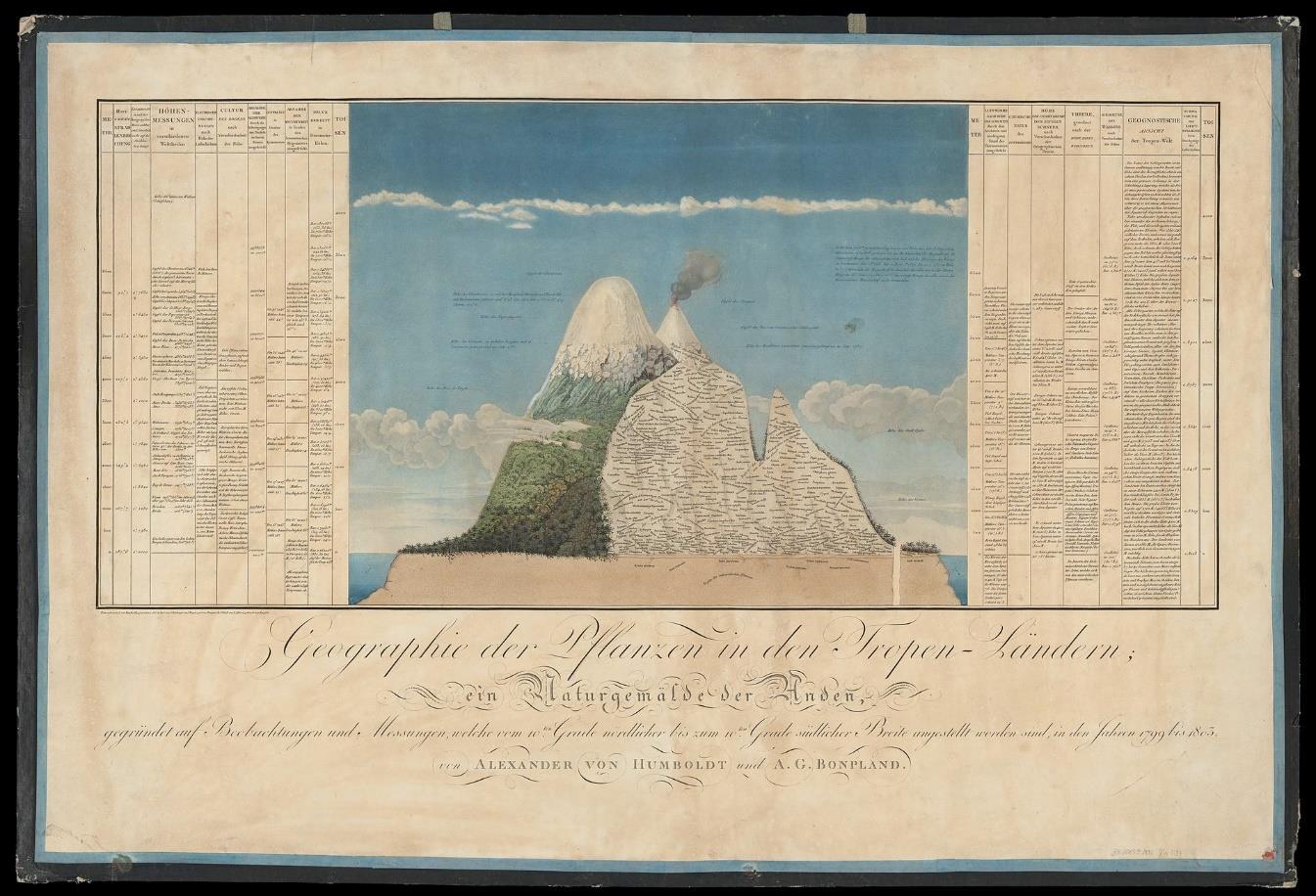
“This variety and richness, but also the simplicity of the scientific information depicted, was unprecedented. Humboldt was the first scientist to present such data visually. The Naturgemälde showed for the first time that nature was a global force with corresponding climate zones across continents,”✓ observes Andrea Wulf (2017, p. 141) in her detailed account and analysis of his life and achievements in the book The Invention of Nature.75 “Humboldt saw ‘unity in variety’. Instead of placing plants in their taxonomic categories, he saw vegetation through the lens of climate and location: a radically new idea that still shapes our understanding of ecosystems today”✓ (p. 141). If nature really is a fabric of life, Humboldt reasoned, he may no longer look at it only as a botanist or a geologist, but must compare data from everywhere about everything with data from other parts of the planet. It was precisely this drawing, and the ideas that shaped it, that were to change the way future generations would see the natural world (p. 146). The book Ideen zu einer Geographie der Pflanzen nebst einem Naturgemälde der Tropenländer was published in Paris in 1805 (also in French under the title Essai sur la géographie des plantes) and is devoted almost entirely to the Naturgemälde. The greater part of the main text of the book was an explanation of the drawing, like a commentary on a painting or a very long caption beneath it (p. 192). The hand-coloured engraving, measuring 90 × 60 centimetres, showed the connections between climate zones and plants according to latitude and longitude. It depicted Chimborazo in cross-section and the distribution of plants from the valley up to the snow line. Beside the mountain, for visual comparison, the heights of other mountains were also marked: Mont Blanc, Vesuvius, Cotopaxi, and the height Gay-Lussac had reached during a balloon ascent in Paris. To the left and right of the mountain were several columns of comparative data on gravity, temperature, the chemical composition of the air, the boiling point of water and other things – all arranged according to altitude. Everything was put into perspective and compared. Humboldt used the new visual approach to please the imagination of his readers, as he told a friend, because “the world likes to see” (p. 193).
Before people really began to engage with nature on a mass scale, they had to confront themselves. Humanity, too, is a kind of “object” that we cannot grasp. It has to be visualised, and a consciousness of humanity was needed first, before a consciousness of its living environment – nature – could step onto the scene. Thus in 1955 more than a quarter of a million people visited the famous photographic exhibition The Family of Man at the Museum of Modern Art in New York. The curator, Edward Steichen, and his assistant Wayne Miller selected 503 photographs of children, men and women, taken through the lenses of 273 photographers. The Family of Man was one of the most popular exhibitions in the history of the museum, and probably the most widely viewed collection of photographs of all time. Copies of it immediately began to travel around the United States, and soon to 37 other countries. In the decade after its opening, seven and a half million people are said to have seen it, and five million catalogues were sold. Since 1994 The Family of Man has been on permanent display at Clervaux Castle in Luxembourg.
After the end of the Second World War and at the beginning of the confrontations of the Cold War, Steichen associated with intellectuals, artists, politicians and other decision-makers. These circles were worried by the global rise of authoritarian regimes and personalities in general. In totalitarian states the mass media created propaganda that passed literally from the mouths of dictators and autocrats to the ears and eyes of the people. Citizens were neither allowed nor able to discuss the messages; they had to accept them uncritically.
The Family of Man (at a time when photography was still something special and television was not yet in every home), through a distinctive installation ranging from small prints to wall-sized photographs, confronted visitors with otherness: other races, polygamous marriages, matriarchal societies and people of different social systems. Its installation allowed a free choice of identification with the images, while nevertheless confronting the visitor with the fact that there are others – different others. The exhibition asked viewers, amid the multitude of images, “to follow their own course among the images, to focus on the pictures that were most meaningful to them, and to knit their subjects into the fabric of their own personalities”✓ (Turner, 2012, p. 57).
It is no secret that the exhibition was conceived on the premise that democracy is the best possible social order in the world. I do not wish to adopt this uncritically as a fact, but for the purposes of the present text I cannot problematise here the question of the legitimacy of spreading democracy. I cite The Family of Man as an argument, a partial support for the reflection on how an image, or a photograph, can change perspective. And when it changes people’s perspective, it soon changes the world. Steichen was rightly reproached for practising a kind of “aesthetic colonialism”. Photography emerged and spread as a means of communication within the broader context of the development of a capitalist world order (Sekula, 1981, p. 16). No previous economic order had constituted the world in such a way, writes Sekula, pointing out that expansionism and capitalism seek to unify the planet into a single economic system of the production and exchange of goods. The spread of democracy is the spread of capitalism, not of idealism. Above all, The Family of Man was “a massive and ostentatious bureaucratic attempt to universalize photographic discourse”✓ (p. 20). It travelled to 69 countries, where it was shown in 85 installations, and by 1978 four million catalogues had been sold. The photograph can be the “’universal equivalent,’ capable of denoting the quantitative exchangeability of all sights”✓; just as money is the universal gauge of exchange value, uniting all the world’s goods in a single system of transactions, photographs reduce all sights [and aspects] to relations of formal equivalence (p. 23) for the exchange of scenes in an aesthetic empire that does not care a whit about their origin, meaning and use.
Although Turner is aware of the observations that the exhibition was supported by, among others, Coca-Cola, and that the Rockefeller family donated money to the Museum of Modern Art in New York, he emphasises the (for us more important) effect of the installation. Even if The Family of Man in a certain sense freed Americans from the one-way reception of information and, with a hitherto unseen installation, invited them to make their own choices and identities, it was nonetheless only an adjustment to a softer but equally pervasive system of management: “Such invitations to construct identities in terms set by the media around us have become commonplace today”✓ (Turner, 2012, p. 58). Although the exhibition (regardless of the criticisms) sincerely championed a more open, tolerant and diverse society, in Turner’s view it helped deliver us into a world in which the media constantly ask us to manage ourselves in terms set by others.
At one point visitors found themselves in a long corridor where, among a row of photographs, a mirror had also been placed, in which visitors saw themselves. Steichen later removed the mirror, but he hoped it would prompt the viewer to reflect on how alike all people are (p. 80). Beside the photographs he placed text from the Russell–Einstein Manifesto: “No one knows how widely such lethal radio-active particles might be diffused, but the best authorities are unanimous in saying that a war with H-bombs might quite possibly put an end to the human race. It is feared that if many H-bombs are used there will be universal death – sudden only for a minority, but for the majority a slow torture of disease and disintegration”✓76 (Born et al., 1997, p. 198). The photograph of a hydrogen bomb explosion was the exhibition’s choke point. Every visitor had to confront the image in order to continue the tour. For Steichen this scene was a forecast of the future that could come to pass if individuals failed to grasp the common features and qualities of humanity (Turner, 2012, p. 80); in the United States it reminded visitors that it was precisely their country, more than any other, that was fuelling the atomic threat of the end of the world.
With the rise of reportage photography, the question of distance and proximity obsessed editors and photographers. The Magnum photojournalist Robert Capa pushed boundaries by documenting American wars at close range and by photographing from bombers at the moment when the bombs from their bellies were hitting targets on the ground. In the same way, engineers carrying out atomic tests wanted to capture the moment of “apocalypse”. During the testing of a hydrogen bomb in 1954 at Eniwetok Atoll, strong winds spread radioactive material over a considerable part of the Pacific Ocean – and caused panic. Distance was no longer a guarantee and a consolation for an isolated public. “Radioactive ash no more obeyed the lines of national borders than it did the concentric circles of the blast map”✓ (Bear, 2010, p. 116).
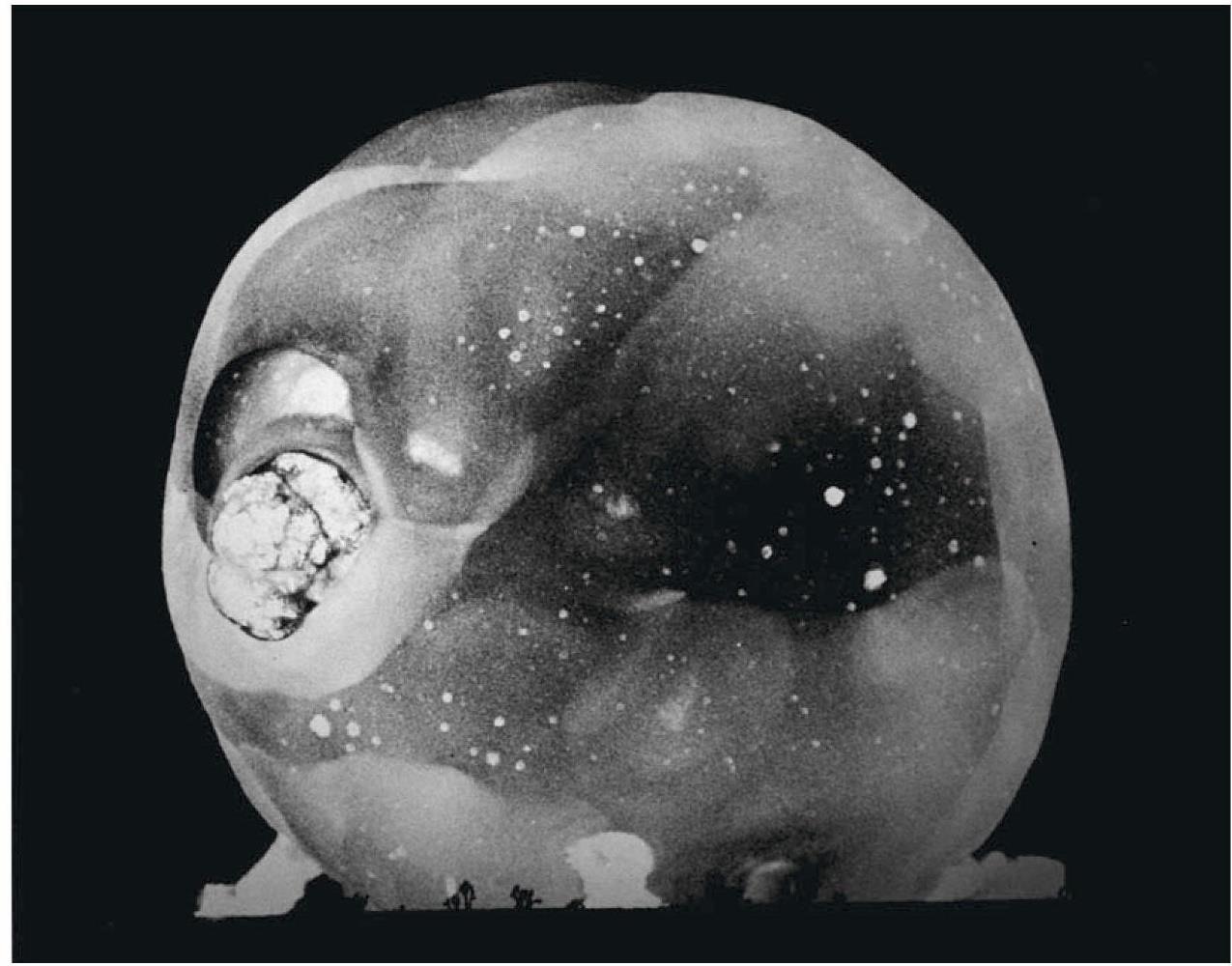
In 1954 the explosion of a bomb anywhere on the planet became a global problem. A detonation would spare no one; distance was immaterial. Photographs taken by automatic cameras during the atomic tests in the Nevada desert in the United States in 1952, at an exposure of a millionth of a second, revealed an image that humanity had not seen at Hiroshima or Nagasaki: the first moment of the detonation expands in the form of a sphere – that which destroys has the same form as that which will be destroyed. Automatic cameras at a safe distance made possible a view that would have been impossible with Capa’s thirst for proximity. The perspective of the Magnum photographer was pushed into the background by an emerging global photographic culture that “the view of the world as if from above, or, better still, as though from outer space”✓ (p. 117).
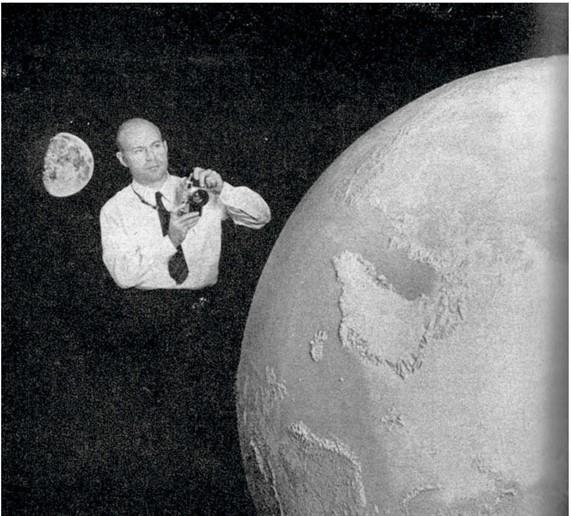
One of Capa’s employers was Look magazine, which competed for readers with Life. In both, in the 1960s, a tendency towards internationalism can be detected, while at the same time the media lacked photographic material with which to truly depict a global perspective. Look’s then picture editor, Arthur Rothstein, was photographed, during the preparation of an article on the International Geophysical Year of 1954, in a telling position: between small models of the Moon and the Earth he circled in “orbit”, creating a photograph for the cover story.
It was dedicated to the geophysical year first proposed in 1950, a global project that intended to link the ever more extensive natural-scientific research around the world into an international project with an entirely clear goal: to obtain a photograph of the planet from outside. Many were convinced that “The view from space would, by virtue of its distance, obliterate the distinctions of political geography which preclude the experience of the world ‘as it really is’”✓ (Bear, 2010, p. 118). The idea that no one really knows what the Earth looks like, because we live too close to its surface, was exciting. In that period photography was becoming the driving force of a new political subjectivity. It was no longer a matter of photographers depicting the world through their own aesthetics and perspectives; it was a matter of photography that began to capture and document the world (Stimson, 2006, p. 24).
What was crucial about The Family of Man was not that it urged visitors to notice their likeness to other races, peoples and customs, but that, through the dispersed arrangement of images in the space around them, it created a new political context (Turner, 2012). In it, visitors had to choose for themselves where to direct their gaze and how to incorporate what they saw into their worldview, which is to a certain extent a process that marks democracy and that, at least at the time, marked the future of the world (p. 82). As Turner writes, less than a year before Rosa Parks boarded the famous bus, Steichen and his assistant created a model for civil rights to which activists could refer. The world of course did not change overnight, but at a moment in American history dominated by gender inequality, racial segregation and hypermilitarisation, they offered a three-dimensional model in which they invited Americans to accept different sexual practices and “members of routinely demonized groups (Africans, Japanese, and Communist Russians and Chinese) as people like themselves”✓ (p. 83), while at the same time Americans were confronted with the call to reject warfare as a crime against humanity.
With so much focus on photography and the image, we cannot pass over the role of television. The period I am describing coincides with the first genuine transnational television broadcasts. In the article “Producing Global Media Memories: Media Events and the Power Dynamics of Transnational Television History”, Lundgren and Evans (2017) describe the beginning of the linking of national television networks and the circumstances of the first such international television projects. They highlight the live television broadcast of Gagarin’s return from space to Moscow in 1961 and, six years later, the BBC programme Our World. The 1960s witnessed “the emergence of television as a global medium, and with it promises of television as a social force and route to universal understanding”✓ (Lundgren and Evans, p. 253). For television to become a global medium in fact, national networks had to develop and build a transnational infrastructure. What set the Gagarin broadcast and the Our World series apart from similar projects is the fact that their realisation required players from both sides of the Iron Curtain to try to come together. At first sight the two television subjects could not have been more different. The first celebrated a national hero and an important achievement in the Cold War race; the second “a celebration of television as a universal force and global medium”✓ (p. 254). It is true that both productions were live programmes, but the images they conveyed to viewers were entirely different. Yet something happened on television for the first time: “the Gagarin broadcast was the first transnational broadcast to cross the Iron Curtain. … Likewise, ‘Our World’ was the first transnational broadcast to encircle the entire northern hemisphere using satellites, allowing viewers to receive images from around the world”✓ (p. 255). In reality only Gagarin succeeded, for a moment, in linking Soviet television with the Western networks. Only a few days before the premiere of Our World, the Soviets and other Eastern European countries withdrew from the project.
Nevertheless, it was precisely the events in space that awakened humanity. “When the first ever man-made satellite, Sputnik I, was launched in 1957, people all over the world went outside, trying to detect the tiny flickering light travelling across the night sky. In a rather peculiar way, they were staring out into the vast nowhere, a territory claimed by no one”✓ (p. 262). The Soviet Union’s choreography of Gagarin’s trip into space was therefore more careful and considered. Footage of the smiling cosmonaut was delivered to Western press agencies the same day, interwoven with scenes of celebration in Moscow and excerpts of space science. His return to the ground was broadcast live, and the programme lasted two hours. What is more, had Soviet television taken part in the Our World project, it would have played an extraordinary role. The programme intended to show, each time, a live broadcast of the view of the Earth from space via the Russian satellite Cosmos 144 or 156 (because of problems with the Intelsat satellite in the spring of 1967), accompanied by the announcer’s words “This is Our World. These pictures are coming directly from the Soviet satellite Cosmos 144 … This is how the small planet we all share looks from the Moon” (p. 264). Surprisingly, the Americans were not enthusiastic about the idea of installing cameras in Shuttle spacecraft. Masumi Kameda (2015) found that they changed their minds precisely because of the Soviet enthusiasm for screening and televising space flights.
Thus, on 24 December 1968, the crew of the Apollo 8 mission in lunar orbit took a photograph of planet Earth entitled Earthrise. This was by no means the first photograph of the Earth from space, but it was the first photograph of the Earth rising, taken from lunar orbit (Appendix 2). In a special issue of Life magazine (2003) on the hundred photographs that changed the world, the famous nature photographer Galen Rowell called Earthrise the most influential environmental photograph of all time. From a centred place within the horizon of a world that must constantly be conquered, appropriated, and in which boundaries must be drawn between oneself and others, the human being rose above the self-evidence of the immediately given world. The Earth ceased to be (also in the aesthetics of nature) a landscape to be framed, travelled through, and whose horizons are to be overcome. From space it lies entirely in the palm of the hand, closed, finite and frighteningly objectified. Humanity’s greatest power – to conquer another planet with technology and inventions – is at the same time the most frightening realisation: that the living environment, as subordinate being (on the surface of the Earth), is finite and set within the much larger perspective of a hostile cosmic space unfit for habitation.
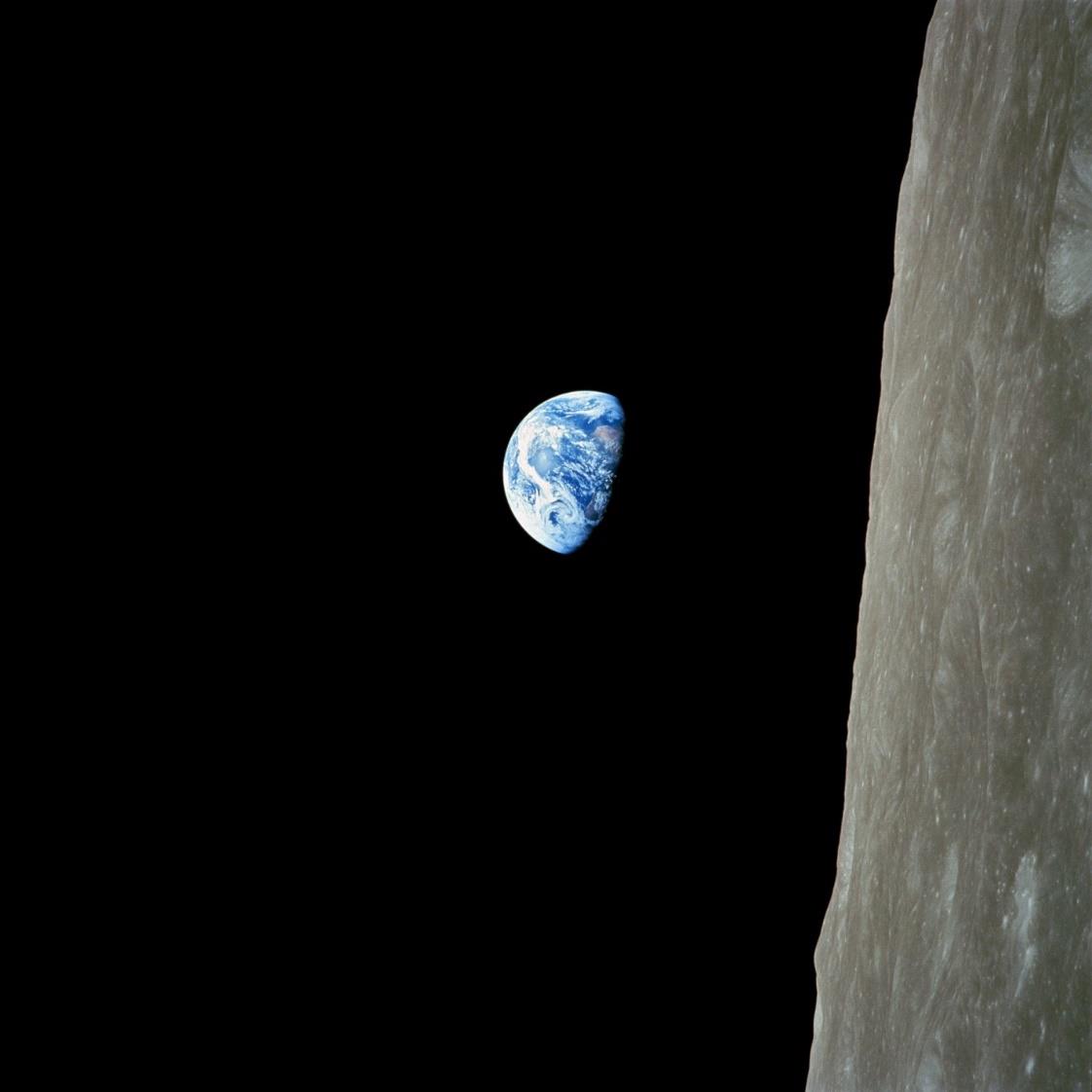
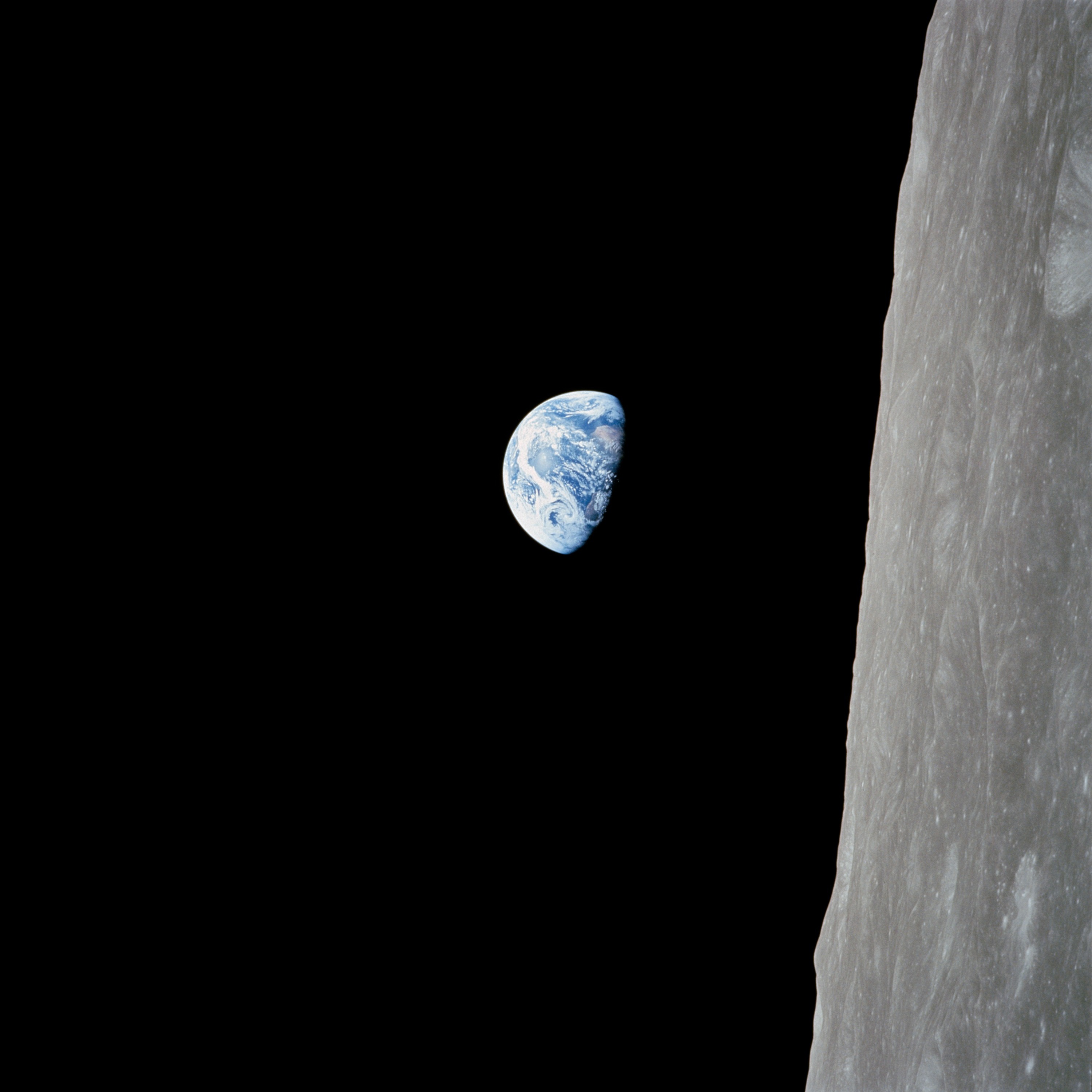
Our terrestrial organic nature is so constructed that the greatest independence (among the great kingdoms of the living) belongs to plants … Among animals, however, the human being, as a meat-eater (carnivore), is of them all the most dependent on other animal beings, writes Scheler (1997, p. 63) about the human being’s deficient biological existence in the text “Človek kot ekscentrik življenja” [“Man as the Eccentric of Life”]. There is no doubt that it is his artificial tools with which he becomes the strongest and mightiest living being with the greatest and widest field of activity and the greatest milieu! (p. 66). There is no biological concept of the essence of the human being, Scheler adds, since this boundary lies not between human and animal but between the person and the organism, between the spiritual being and the living being (p. 69). With flights into space, the conquest of the Moon and the placing of satellites into orbit around the Earth, the notion of the “greatest milieu” acquired an entirely new meaning. In the horizontal perspective the world is larger than the human being. It is the human being who is its object – vulnerable, fragile and exposed. The world must be mastered, subjugated, its dangers driven away. In orbit the Earth becomes an object. The human being, as a being of the “greatest milieu” and of “artificial tools”, becomes aware that his boundary is in reality a closed sphere. He cannot (yet) live anywhere else; he knows no other place to go. In an infinitely large space, his whole existence depends on a tiny stone near the Sun.
With his own eyes a person sees little of the world. For an earthling it is simply impossible to travel the whole planet and experience his living space at first hand. The truth is that most people do not explore and experience even their own town, let alone their country. In the age of globalisation, a person experiences most of the “world” through images on the many screens of everyday life. What connects us is not the experience of life, reality or contact, but the images and ideas that represent them. We do not experience the globalised and networked world and its citizens; we receive it mediated and presented through the media, social networks, the World Wide Web and other technologies. The debate about what photographs actually are has been going on for decades (Alward, 2012), and at the same time we cannot get around the fact that a photograph is frozen in time and space, while what is photographed lives on. Of course, representational features may persist for many years, but the photograph itself is, the very next moment, already a photograph of something else (Zeimbekis, 2012). The photograph of the Earth is a “generic” photograph. It may be a few minutes or a few years old. A layperson will not recognise the difference. How, then, could the perspective of the Earth from space be important for the question of the aesthetics of nature? Astronauts and cosmonauts of different generations report the overview effect,77 a profound (in some cases mystical) experience that transformed them completely. The view of the Earth from space filled most of them with feelings of wonder, of great admiration, of oneness with nature, of transcendence and of the shared destiny of humanity (Vakoch, 2011, p. 29).
In the book The Overview Effect (1998), Frank White described the similar experience of astronauts confronted with the view of the Earth from space: space travellers mostly agree that experiencing the overview effect includes the realisation that the Earth floats in infinitely vast interstellar space and that, surrounded by a thin protective layer of atmosphere, it is extremely fragile and vulnerable. It includes the realisation that, from so distant a perspective, borders, differences and otherness are unimportant. The inhabitants of space settlements will always have an overview! They will be able to see how everything is connected, that what seems to people on Earth to be “the world” is in reality a small planet in space, and that, from such a perspective, the “present” is a limited point of view. People living in space will immediately grasp philosophical insights that took earthlings thousands of years to put into words (White, 1998, p. 4).
Space missions, admittedly, are not romantic journeys full of enthusiasm for the planet. Every minute of astronauts and cosmonauts is filled with tasks, chores and checks78 of systems. Just the damn Himalayas, the Apollo 7 astronaut Walt Cunningham replied, for instance, when asked what he had been able to see through the spacecraft’s windows (Oliver, 2012, p. 99). Life in space takes place in small and cramped quarters. On missions in the 1970s the windows were often too small or dirty, or the light was too strong for any chance of magnificent views. Life magazine doesn’t talk about these things, added the module pilot Ken Mattingly, meaning the stench, the dirt and the impossibility of maintaining proper personal hygiene in space. The smell in the Apollo 16 capsule on its return to Earth was so unbearable that the diver who swam up to the hatch in the sea jumped aside and slammed it shut again.
It is perfectly obvious that space missions in the United States had the status of a religion. With all the characteristics of a religion, human space exploration receives a special treatment found in only a few American movements, Launius states (2013, p. 46), noting that religious ideas appear everywhere in the American space programme. Among them we find faith, worship, reverence, salvation and (national) heroes. Despite difficult personal, hygienic, spatial and temporal conditions, the astronauts nevertheless described states in which deeper experiences spoke to them. After the Moon landing, on one of the later missions, the crew of Apollo 17 in 1972 took what is supposedly the most reproduced photograph in human history, entitled The Blue Marble. The Sun was directly behind them, and so one of the first photographs of a fully illuminated Earth came into being. On the fortieth anniversary of this event (and more than a quarter of a century after the testimonies in White’s book), the filmmakers’ collective Planetary Collective79 made a short film entitled Overview (Reid, 2012), in which, among others, the Apollo 14 astronaut Edgar Mitchell explains that after returning to Earth he tried to make sense of what had happened to him on the mission.
He had experienced the overview effect so powerfully that he first searched through scientific and religious literature, but found no description anywhere. He turned to a nearby university, and a few weeks later he learned that his experience corresponded most closely to the description of the religious bliss of savikalpa samādhi. In ancient Indian religious writings such a state is described as the contemplation of things as we see them with our eyes, with the difference that the observer at the same time emotionally and bodily experiences the ecstasy of a feeling of fusion and oneness with creation. The body is as if in a trance, but consciousness is fully aware of the experience of bliss in the spirit (Yogananda, 2007, p. 101). Interestingly, Mitchell’s experience, as he himself notes, is not new; White used his account to draw attention to the overview effect in various contexts, including among earlier civilisations.
Astronauts were expected to devote all their attention to operational tasks, not to gaze through the windows into interstellar space and observe the Earth. If anything was to fascinate them, it was certainly not supposed to be the Earth: It did not quite go according to plan, and it is precisely between such expectations and what they actually watched, did and perceived that the boundary of spiritual and philosophical meanings lies. The dimension of human space missions that filled consciousness with new thoughts about beauty, order and scale, about the Earth, God and the cosmos, is modest but real, reflects the otherwise critical Oliver (2012, p. 136), who is convinced that for precisely this reason space missions should continue. People confronted with the overview effect in some cases undergo just as powerful and even more unpredictable a transformation as astronauts, White is convinced (1998, p. 67), and he calls individuals who have arrived at astronaut “consciousness” without travelling into space “terranauts”.80
An even more important role than the astronauts’ experiences in establishing the overview effect was played by the Landsat satellite,81 which has taken millions upon millions of photographs of the Earth’s surface. These are far more detailed than the photographs of the whole Earth from space missions. They show river basins, forests, cities, deserts, glaciers and oceans, and over more than a decade scientists have also used them to record changes in nature and the environment caused by humans. Landsat’s collections of photographs of the Earth’s surface are a reminder and a peephole into yet another, different perspective, which in the aesthetics of nature once again opens up analogies with art, abstract painting and formalism. The change of perspective opens up an even more interesting field: the more the aesthetics of nature tries to flee82 from parallels with aesthetic approaches in art, the more, by long detours (in certain cases), it returns to them again. The debate in this field is not yet over, nor can it easily be dismissed.
More surprising is the finding that the relation to the cosmos and the “expansion of the self” are no novelty in philosophy at all. In What Is Ancient Philosophy? the French philosopher and specialist in ancient philosophy Pierre Hadot also discusses them. He writes that one of the spiritual exercises recommended by Plato consists in a kind of expansion of the self into the totality of the real (Hadot, 2009, p. 217). Such too is the Aristotelian contemplation of nature, which leads from the loving gaze at the stars to the wonderful pleasure offered by the works of Nature; even among the Epicureans we find the expansion of the self into the universe, since such a practice brings delight in immersion in the infinite, writes Hadot, adding that among the Stoics, for whom the world was finite and unique, this exercise did not involve expanding the self into the infinity of the universe, but into the infinity of time, within which the same course of events that constitutes the world is eternally repeated (pp. 218–219). Long before Kant, the exercise for thought and imagination in all the schools that prescribed it consisted, for the philosopher, ultimately in becoming aware of his being within the All as a small point of brief duration, which is nonetheless capable of expanding into the immense field of infinite space and of grasping the totality of reality in a single act of knowledge, explains Hadot (p. 220). It was an exercise in detachment, an exercise in the impartial and objective contemplation of things.
In the Theaetetus, too, the one who seriously engages in philosophy is defined by a telling description: “The lords of philosophy have not learned the way to the dicastery or ecclesia; they neither see nor hear the laws and votes of the state, written or recited; societies, whether political or festive, clubs, and singing maidens do not enter even into their dreams. … Neither are they conscious of their own ignorance; for they do not practise singularity in order to gain reputation, but the truth is, that the outer form of them only is residing in the city; the inner man, as Pindar says, is going on a voyage of discovery, measuring as with line and rule the things which are under and in the earth, interrogating the whole of nature, only not condescending to notice what is near them”✓ (173d–e). Translator’s note: Jowett’s rendering is notably free; the Slovenian translation cited follows the Greek more closely, including Pindar’s “now beneath the earth … now above the heavens”. For the philosopher who traverses the expanse of reality, all the affairs of people and of the world and all human property become insignificantly small, since, hearing of great landed estates, he “thinks of the whole earth”✓ (Plato, 2004, 174e).
To look from above is to look from the standpoint of transience, Hadot is also convinced, but he has a somewhat different view of what this means: In both cases it is to look at things with indifference, detachment, distance and objectivity, as they are in themselves, and in doing so to resituate them within the immensity of the universe, within the totality of nature, without adding the false charms bestowed on them by our passions and by human conventions. The view from above changes our value judgements about things (Hadot, 2009, p. 222). Awareness of oneself, whether in concentration on oneself or in the expansion of the self into the universe, always demands an exercise in death, which, as Hadot observes, has been a kind of essence of philosophy ever since Plato. Few can be indifferent in the face of death. Rather, in the face of such views and vistas we experience different emotions. The aesthetics of nature is rarely an exercise in death; rather, it is an exercise in joy.
Something similar was argued in The Sense of Beauty by the Spanish-born American philosopher George Santayana, who in §11 defines beauty in words that would surprise many: “Beauty is pleasure regarded as the quality of a thing”✓ (Santayana, 1955, p. 31). Translator’s note: the Slovenian text renders Santayana’s “pleasure” as radost, “joy”, which motivates the preceding sentence. He adds that an object simply cannot be beautiful if it arouses pleasure in no one. Uršič points out that the title of the work refers not only to the “feeling of beauty”, the sense of beauty and “a feeling for beauty”, but also to the “meaning of beauty” (Uršič, 2010, p. 571). Translator’s note: the Slovenian smisel means both “sense” and “meaning”. What is especially interesting in Santayana is his remark on the beauty of the stars: “To most people, I fancy, the stars are beautiful; but if you asked why, they would be at a loss to reply, until they remembered what they had heard about astronomy”✓ (Santayana, 1955, p. 64). What we know about the stars, their origin, history and life cycle, is not essential to our experience of their beauty, he is convinced. Astronomical knowledge changes, as we also see above, yet the stars were admired before us. Uršič observes that in Santayana’s epistemology the sensuousness of what we admire is far more important for the feeling of sublimity. Theories change; sensuousness remains untouched: For Santayana, beauty is a firmer “ontological” foundation of reality than thought, than “mere ideas” about the world, nature, the universe … What is essential to the feeling of the sublimity of the sky is therefore its sensuous beauty, which in its complexity and splendour surpasses all human artefacts (Uršič, 2010, pp. 574–575). It is therefore not only a matter of the immense extent and size, power or might of the starry sky. Kant’s opposition between the mathematical and the dynamical sublime is, on such a view, rather unnecessary. “Nothing is objectively impressive; things are impressive only when they succeed in touching the sensibility of the observer, by finding the avenues to his brain and heart,”✓ writes Santayana (1955, pp. 65–66). For the view of the Earth from space, his observation about the view of a multitude of stars and of a single star is important. A single star makes an entirely different impression and is “tender, beautiful, and mild”✓ (p. 67) – far, then, from sublimity.
Almost thirty years before Sepänmaa worked out the question of beauty in landscape and environment in The Beauty of Environment, Santayana had already offered exactly the same insight, as other philosophers in debates on the aesthetics of nature have also affirmed (see Carlson, Berleant, Kante …). He found that natural landscape is indeterminate, varied, and offers itself to the eye to arrange and bring together. In §33 he writes that “A landscape to be seen has to be composed, and to be loved has to be moralized. That is the reason why rude or vulgar people are indifferent to their natural surroundings”✓ (Santayana, 1955, p. 83). With Kant I wrote that the world is more moral because of the sublime; with Santayana we could say that it is so because of beauty.
7.1. The Hubble Telescope and Space Landscapes: The Problem of the Sublime in Space
If the astronauts’ experience of the overview effect described above is not (by definition) sublime, what is it then? Should the aesthetics of nature add to the beautiful and the sublime a definition of the experience of the view of the Earth, for which there is not yet an (adequate) name? Space and time, as the a priori forms of sensibility, direct us towards developing an aesthetic view of the world and of life which, in the manner of ancient wisdom, should be in harmony with, or even identical to, what is also true and good, reflects Igor Škamperle in the book Dotiki pokrajine [Touches of Landscape]. Of course, for the contemporary person such a conclusion is exaggerated. Life, namely, in the age of so-called liquid modernity has become dispersed, burdened by technical acquisitions, constant communication and visual representations on small screens, which often replace the “real” natural world around us (Škamperle and Mezgec, 2012, p. 8). The warnings of social scientists about deterritorialisation, or the severing of traditional ties that connect the individual, as well as the local and national community, with a concrete natural and geographical space (p. 8), are apt. Who still has time for the leisurely contemplation of nature and its rhythms, Škamperle further asks.
What, then, are we talking about at all? Certainly not about beauty as an “I know not what”, or je ne sais quoi, as Umberto Eco termed the beauty that words cannot describe. We do not want to adopt the inclination of the Italian poets to make a mystery of everything with their “I know not what” (Eco, 2006, p. 310). In the battle of Romanticism against civilisation, a weapon other than reason must be taken up: Nature itself, set against the falsity of history, comes to seem dark, formless, unfathomable: it cannot be captured in precise, pure forms, but shakes the observer with majestic, sublime scenes. That is why the Romantics do not describe its Beauty but experience it directly, knowing it instinctively by throwing themselves into its embrace. And since nocturnal melancholy is the feeling that best expresses this immersion in and fusion with nature, the night wanderer, the person who surrenders to restless roaming in the moonlight, is also Romantic (Eco, 2006, p. 312). Yet this is not the melancholy of despair and the lack of a will to live, Kant warns: A person whose feeling tends towards the melancholic is not called melancholic because, robbed of the joys of life, he languishes in gloomy sadness, but because his feelings, if they were to grow beyond a certain limit or for some reason took a wrong direction, would more easily turn into sadness than into any other state. He has above all a feeling for the sublime (Kant, 1937, p. 14).
In the Critique of Judgement Kant does not treat the sublime as an appendix to the theory of the beautiful, but connects it with the concept of purposiveness in nature, Kante emphasises, adding that the sublime in Kant is distinctly teleologically coloured (Kante, 2009, p. 162). The teleology of nature appears by analogy with beauty in art, but despite the closeness of beauty and the art of nature, in Kant it is not simply a matter of reducing the teleology of nature to aesthetics, but of their convergence in the human power of judgement, adds Uršič (2010, p. 517). Because of the sublime, put simply, the world is therefore more moral.
In the case of beauty, Kant emphasises the property of form. For him the beautiful is that which pleases taste “apart from any interest”✓ (Kant, 1999, p. 51). Beauty is no longer a property of the object; it must be sought in the process of aesthetic appreciation. On the other hand, the beautiful in nature, too, is above all a question of the form of the object, which is why it is precisely form that draws the sharp boundaries separating the sublime from the beautiful, or, as Kant says: “the sublime is to be found in an object even devoid of form, so far as it immediately involves, or else by its presence provokes a representation of limitlessness, yet with a superadded thought of its totality”✓ (p. 84). In the case of the sublime, purposiveness lies only within the mind itself and its moral ideas, not in the space and time of things in the external world. The experience of the sublime turns a person away from the external towards the inner world, since the external world is not adequate for expressing the contents of the sublime, which are connected with infinity (Kante, 2009, p. 163).
Kant divides the sublime into the mathematical and the dynamical. The starry sky, for instance, is mathematically sublime, while an example of the dynamically sublime is a storm on the ocean – in the sky it is a matter of the immeasurability of magnitude, in the ocean of the immeasurability of might. “Sublime is the name given to what is absolutely great”✓ (Kant, 1999, p. 88), “that is sublime in comparison with which all else is small”✓ (p. 90), and “The sublime is that, the mere capacity of thinking which evidences a faculty of mind transcending every standard of sense”✓ (p. 91). If we understand the sublime as the absolutely great, Kante explains, we cannot seek it in natural things, but only in our own ideas. As for the second, relational definition, there is no thing in nature, however great we may experience it, that we could not, in some other relation, regard as smaller – and vice versa. That is why we cannot call anything that is an object of the senses sublime (Kante, 2009, p. 163).
On this interpretation of Kant, the feeling at the sight of the Earth cannot be called sublime. The experience of savikalpa samādhi is different – it does not involve the shudder and the “hesitation” of the power of judgement. Savikalpa does not divide the self from the object as the experience of the sublime does. On the contrary, some astronauts centre the experience of seeing the Earth on the experience of the planetary whole, the sphere, and fuse with it in a feeling of oneness that manifests itself in an ecstasy of the whole body. Sublimity, moreover, unlike the descriptions of experiences of savikalpa, is not ecstatic, but by comparison a rather sober experience.
We can hardly reproach him for anything, since Kant did not have at his disposal the perspective from space that is today accessible to anyone who knows how to use a web search engine. He himself says that “the feeling of sublime involves as its characteristic feature a mental movement combined with the estimate of the object, whereas taste in respect of the beautiful presupposes that the mind is in restful contemplation, and preserves it in this state”✓ (Kant, 1999, p. 87). Uršič rightly asks whether the stars do not in fact fill the soul more with peace than with movement. And besides, he adds, [w]here is sublimity, “in myself” or “up there”? (Uršič, 2010, p. 568). Kant’s answer is clear and rejects the cognitive approach armed with scientistic data and knowledge. We must take the sky “just as it strikes the eye, as a broad and all-embracing canopy”✓ (Kant, 1999, p. 199). Sublimity lies in the representation that the pure aesthetic judgement attributes to the object; “true sublimity must be sought only in the mind of the judging subject, and not in the object of nature”✓ (p. 96).
In Uršič’s view, Kant does not seek sublimity in science, rational cognition and the ideas of reason, but only in aesthetic contemplation, because he already defines it as magnitude and might, which are inaccessible to theoretical cognition since they lie beyond all possible experience – but he does not take into account (or at least not explicitly) sublimity as the depth and bottomless mystery of the world, of nature, of the universe (Uršič, 2010, p. 569). The “teleological” beauty of the Earth and its mysterious presence in the neighbourhood of planets unfit for life are something special. When we observe our planet from orbit, it represents neither immeasurable magnitude or might nor something that the power of judgement would try to objectify from infinite magnitude into a finitude more congenial to us. In such a perspective the Earth is already an object, placed in the company of the Sun, the Moon, the stars and other planets. We can hardly say that it pleases us disinterestedly, as, say, a passion flower pleases us, since we are vitally dependent on it (in orbit we are probably especially aware of this). Without its atmosphere and gravity our body slowly deteriorates in the spacecraft. At the same time we can also reflect on the essential difference between the mathematical and the dynamical sublime: both states share an initial displeasure, but in Kante’s view it is a different kind of displeasure: The feeling of the mathematically sublime involves the frustration of the power of the imagination to comprehend the object, but there is no element of fear present in it, whereas the feelings of the dynamically sublime are grounded in an initial fear of a threatening object (Kante, 2009, p. 168).
Kant offers examples: “Bold, overhanging, and, as it were, threatening rocks, thunderclouds … volcanos in all their violence of destruction, hurricanes …, the boundless ocean rising with rebellious force, the high waterfall of some mighty river”✓ (Kant, 1999, p. 101). Berleant has an interesting remark on this theme concerning an “updating” of the mathematically sublime. He is convinced that the mathematically sublime is not only the starry sky but also extreme environments on Earth: A similar condition arises in the vastness of continental deserts and ice-bound continents. These deserve the name “sublime”, since here too an all-powerful, though simple, nature bursts beyond the bounds that otherwise permit disinterested contemplation (Berleant, 1992, p. 167). The aesthetics of nature, in a real desert or on an ice continent, experiences a pervasive feeling of unfathomable extent, magnitude and awe.
It is hard to draw conclusions on the basis of photographs, and harder still to imagine what the Earth really looks like from space, but astronauts do not report the feelings in the face of sublime phenomena that Kant, for instance, reflects on: “provided our own position is secure, their aspect is all the more attractive for its fearfulness … in just the same way the irresistibility of the might of nature forces upon us the recognition of our physical helplessness as beings of nature, but at the same time reveals a faculty of estimating ourselves as independent of nature, and discovers a pre-eminence above nature”✓ (Kant, 1999, p. 102). The sight of the Earth is supposedly not fearful, but rather lovingly aware of how unfathomably dependent we are on its hospitality. Of how, in truth, together with it we are powerless in the boundlessness of the universe. “Pre-eminence” over nature, in the case of the perspective from space, is above all the awareness of humanity’s power to destroy an environment that is fragile, unique and necessary for its life. The feeling at the sight of the Earth is (perhaps?) too powerful for us to be content with placing it in the category of the beautiful, while at the same time it is contrary to what holds for the category of the sublime. What are the possible ways out of the impasse?
Kant’s conception of the sublime in the aesthetics of nature requires that we be safe. But now we are no longer safe anywhere, and what appears to us is no longer either the mathematically or the dynamically sublime, but our own ethics of the maximum, which follows the position of modernity: we must be capable of realising what we are not capable of. The Aristotelian ethics [of the right measure] must, in order to delimit happiness from unhappiness, constitute a limit beyond which transgression, excess, begins. This limit, which the human being cannot cross, is pleasure … Kant’s morality of the law and the Christian commandment of love, however, universalise what for Aristotle is the exception: everyone must be capable of the impossible (Šumič-Riha, 2002, p. 11). To realise all the subject’s capacities does not mean exhausting all existing possibilities, but creating possibilities out of the impossible – by crossing a limit that seems uncrossable … The ethics of the maximum presupposes the bracketing of the subject’s interest in self-preservation, the bracketing of the subject as a subject of pleasure … it demands of a finite, mortal being that it act as if immortal (pp. 12–13). The consequences are mountaineering and Himalayan records, the enormous boom of ultramarathon running among people who do not do it for money or as their profession. The reality of the contemporary is the reality of surpassing everything and everyone: records, limits, territories and others. And nature.
Uršič’s remark that Kant does not take into account the depth and bottomless mystery of the world is welcome in the case of the view of the Earth from space. A new perspective in the aesthetics of nature, one that goes beyond the horizontal view of landscape and extends the concept of nature to the universe as well, challenges the concept of the sublime and at the same time opens the question of what we should then call the feeling at the sight of the Earth. At least for the moment there is no name for it. In the light of Uršič’s reflection on the starry sky as a “museum of natural history”, the view of the Earth becomes still more worthy of attention. When we look deep into the universe, when we observe in our telescopes distant galaxies that are millions, even billions of light years away from us, we are looking into the past of our universe, since light – which only seems to travel at infinite speed – travels rather slowly across the vast expanses of the cosmos (Uršič, 2011, p. 227). In Uršič’s words, this is the sublime miracle of modern science. The starry sky is in truth a record of the past of the universe, its history, and at the same time a reminder of its constant transience. Which of the stars are still really shining at all, and which are sending towards us their last, dying cry of light?
What is really out there? What is the background against which the traveller in a spaceship views the home planet? If anything is terrifyingly “mathematically-dynamically” sublime, it is dark matter. If we take matter, both visible and invisible, to be about 30 per cent of the critical density, then the accelerated expansion observed by researchers requires the push of a cosmological constant whose dark energy contributes about 70 per cent of the critical density. This is a remarkable number, Greene notes (2005, p. 324), drawing attention to the fact that ordinary matter – protons, neutrons and electrons – makes up barely five per cent of the mass/energy of the universe, while some as yet unknown dark matter makes up at least five times that amount, and the majority of the mass/energy in the universe is contributed by an entirely different and somewhat mysterious form of dark energy spread throughout the universe (p. 324). This is important for the perspective of the view of the Earth from space in the aesthetics of nature. If the claim proves true, the Copernican revolution was only the beginning. That we are not the centre of the universe we already know; that we are merely flotsam in the cosmic sea, and that without all the protons, neutrons and electrons the mass of the universe would hardly diminish, is an entirely different realisation. The Earth becomes (for us) all the more important.
At the same time, given that most of the starry sky is in truth a dance of light traces from our past, oceans of possibility open up for the aesthetics of nature. If we point a powerful telescope at a tiny scrap of sky and, after ten days of gathering light, can see 10 billion years into the past, and rightly conclude that the phenomena observed are “in reality” no longer there (or are different, or have been replaced by others), then we can confirm our thesis that in the case of the aesthetics of nature of the universe, too, we develop the discipline with the help of images, or photographs. In such a case radical aestheticians of nature would also retort that we are beginning to erase the boundary between the natural and the artefactual. The lenses of cameras and telescopes are, after all, just another perspective for capturing different parts of the light spectrum, and are an entirely artificial (and artful) product. Translator’s note: the Slovenian umete(le)n plays on umeten, “artificial”, and umetelen, “artful, skilful”. It is one thing to cite Kant, who relied on intuition, the a priori forms of sensibility and the human being on a walk; it is quite another when we bring into play spacecraft and telescopes several metres in diameter. All these are as yet unexplored beginnings of contemporary problems in the aesthetics of nature – seemingly exaggerated and audacious, but welcome thought experiments for questioning the boundaries of the discipline.
7.2. Environmental Imagination: Visualising Natural Space
The possibility of looking into space and from space at the planet (or of viewing the surface of the Earth with Google Maps) has given the scenic-landscape perspective of nature, on a flat plane reaching to the horizon, an entirely new dimension. The fragmented landscapes of different cultures, traditions, mythologies and histories have merged into a comprehensive aesthetic unit – planet Earth. In the aesthetics of nature this is a turn from the perspective of the traveller-explorer to the perspective of the lens, which transmits from space images of views that we ourselves cannot observe. Nature in this sense can no longer be only landscape, forest, oceans and the rest of the Earth’s surface. The natural, in the sense of the interest of the aesthetics of nature, is also the whole universe itself. I propose that we extend the concept of nature in the aesthetics of nature to the whole universe. The existing discourse on the artefactual certainly makes sense in the “microcosm” of the immediate givenness of nature in landscape; perhaps it also makes sense a few hundred kilometres above the Earth’s surface, where thousands of satellites crowd in numerous low, medium and high orbits. Perhaps it makes sense on the Moon, where astronauts left footprints and planted the American flag. Perhaps also on Mars, across which NASA’s rovers have cruised. The “influence”, if we may call it somewhat pretentiously, of humanity in space reaches as far as the place in interstellar space that the Voyager probe has managed to reach; the rest of the universe is in this respect “unblemished”.
Beyond that, the discourse on the artefactual makes sense only at the level of images. What do I mean by this? The picturesque images produced with the help of space telescopes such as Hubble gather light billions of years into the past and are not instantaneous shots, but hundredfold exposures of small patches of the cosmic sky, which to the naked eye is completely black. An image made possible by technology, which we could otherwise never behold with the naked eye “in nature”, is also an artefact. I am convinced that the debate about the natural and the artificial is fruitful only at this level, or, as Parsons soberly observes: Although many things happen because of our presence, many do not … Natural phenomena such as insects and plants, and natural events such as the falling of rain and the mating behaviour of birds, are all around us, even in the middle of the greatest cities of our civilisation (Parsons, 2008, p. 3). This is one way of looking at the relation nature – culture – artefact; there is also the reverse approach: “When you feel raindrops, you are experiencing climate, in some sense. In particular you are experiencing the climate change known as global warming. But you are never directly experiencing global warming as such”✓ – thus Timothy Morton introduces the concept of hyperobjects in the book Hyperobjects: Philosophy and Ecology after the End of the World (Morton, 2013, p. 48). [Added in the English edition: see also the author’s afterword to the Slovenian edition of Hyperobjects, “An Obituary for Ecology and a Manifesto for Positive Environmentalism”.]
Hyperobjects turn the traditional understanding of objects on its head and thereby unsettle the relation between subject and object. They are objects that we humans simply cannot see, since they elude the representational power of the mind, or cannot in any way adequately be (in Kantian language) apprehended. They are distributed through space and stretched through time in units alien to human comprehension. A hyperobject can be an oil slick in the Gulf of Mexico or Yellowstone National Park. A hyperobject can be the biosphere or the solar system. A hyperobject can be the sum of all nuclear materials on Earth, or just all the plutonium or uranium. It can be a very durable human product, such as all the polystyrene in circulation. Hyperobjects are “hyper” in relation to other entities, regardless of whether or not they are produced by humans. We might think of the sublimity of the Kantian infinite, but we would be mistaken: Hyperobjects are not eternal. What they offer is a very large finitude (Morton, 2013, p. 60). Global warming is viscous. Wherever we go, it is always already here; it clings to us and will not release us from its grip. The half-life of plutonium-239 is more than twenty-four thousand years, which is almost as long as visible human history. In the age of the Anthropocene,83 when in two hundred years we have pumped carbon out of the Earth and released it into the atmosphere, the aesthetics of nature cannot be as it was in Romanticism: “Thinking things as Nature is thinking them as a more or less static, or metastable, continuity bounded by time and space. The classic image of Nature is the Romantic or picturesque painting of a landscape. There it is, over yonder—on the wall in the gallery”✓ (Morton, 2013, p. 72).
It is precisely for this reason that Humboldt’s Naturgemälde and the Family of Man exhibition were necessary. A very large finitude can be grasped only through pictorial representation. In the Anthropocene we are suddenly surrounded by multitudes of “very large finitudes”, and thus objects in the classical sense have been replaced by hyperobjects. We do not see four hundred particles of carbon per million molecules of air with the naked eye, but powerful instruments detect them, and computers draw them for the human mind in the form of graphs and tables – in this case the Keeling curve. Carbon dioxide in the atmosphere is the consequence of human activity, yet in a certain sense it is natural. Only science gives us access to hyperobjects, and with them to an entirely different picture of nature. Just as in space we cannot see far without the powerful lenses of telescopes, on Earth without still more powerful microscopes we can no longer see anything. The Earth, seen from space, is no longer “nature” but a hyperobject. So is the whole universe.
Such is the whole cosmic landscape.
What kind of perspective this is can be better understood with the help of the concept of “environmental imagination”, which Irene J. Klaver places alongside the principles of Benedict Anderson’s Imagined Communities. Anderson defines the nation as an “imagined political community”.
It is imagined because even the members of the smallest nations will never know all their fellow citizens, meet them or know everything about them – yet all of them have some image of the community and live with it. They sustain it with the help of the mass media, which give them the feeling that they are part of the community and of shared events when, in the intimacy of their own homes, they follow the events of the “community” on their own. Klaver wants to extend theories of the cultural and social imagination with environmental imagination84 (Drenthen and Keulartz, 2014, p. 143). The photograph of the Earth rising from lunar orbit is for her a symbol of the human community: It began to interact with the image of the nation-state, in some cases even surpassing it, but for the most part it operates at the level of the nation (p. 144). If we humans were capable of imagining the community of the nation, then after the resonant images from space we are capable of imagining our (global) community/environment of the planet. With the help of environmental images we imagine the wider environment on Earth and in space, to which we never actually travel. Such mediated experience of the wider environment is characteristic of a shallow aesthetics of nature. We experience it on the computer or television screen, in magazines and on social networks. Nature thus mediated is imaginary, wholly imagined. We know that we are part of our solar system, and we can imagine that thousand-year-old sequoias grow in California, but none of this have we (perhaps) really experienced and seen.
Notes
- While this dissertation was being written, the publisher Umco, on my recommendation, began preparing a Slovenian translation of The Invention of Nature. ↩︎
- Translated [into Slovenian] by Gita Zadnikar. Translator’s note: the passage is given here in the original English wording of the Manifesto. ↩︎
- English: overview effect. Translator’s note: the Slovenian text uses the calque pregledni učinek. ↩︎
- The technology of the first flights demanded the crew’s constant care and attention; time in space is still extremely precious today. ↩︎
- http://www.planetarycollective.com ↩︎
- I have also written about the Blue Marble photograph and its role in the twentieth century in the article “Modra frnikola: podoba, ki nas je spremenila v teranavte” [“The Blue Marble: The Image That Turned Us into Terranauts”] (Mazi, 2015) for KSEVT’s thematic strand Space Vision (Vesoljski vid), which explored iconic images of the invisible that emerged as a by-product of more than fifty years of space exploration. As part of the project, various exhibitions of iconic images and of real space photographic equipment were on view until the end of 2016 at the Cultural Centre of European Space Technologies (KSEVT) in Vitanje. The text of the article accompanied the photograph of the Blue Marble at the exhibition. In 2013, at the international colloquium of the Slovenian Society of Aesthetics (26–28 September), I presented the paper “Geostationary Aesthetics of Nature” (Mazi, 2013). ↩︎
- http://landsat.usgs.gov/ ↩︎
- See: Kante, B. (2008). Naravna in umetniška lepota pri Kantu: svobodna in zgolj pripadajoča (pogojna, odvisna) lepota [Natural and Artistic Beauty in Kant: Free and Merely Adherent (Conditional, Dependent) Beauty]. Analiza, 12, no. 3. ↩︎
- If in the 1970s we could still underestimate and speculate about human influence, today, in the strict discourse of the artefactual versus the natural and in the light of the demand for the absence of human influence, nature no longer exists. See: Weisman, A. (2009). Svet brez nas [The World Without Us]. Moreover, while this dissertation was being written, scientists officially confirmed a new geological epoch – the Anthropocene (Hettinger, 2014). ↩︎
- English: environmental imagination. ↩︎